

Most organizations send the same RFP they drafted three years ago, swap out the date, and call it done. The problem is that the media monitoring landscape has changed significantly.
The AI-driven analysis, sub-second alert delivery, broadcast and podcast coverage, and multilingual sentiment tracking are now table stakes for teams that manage brand reputation at scale. An outdated RFP attracts vendors who match outdated expectations.
If your current monitoring setup has ever left you finding out about a news story from a colleague, a client, or worse, a journalist calling for comment, your RFP process is part of the problem.
Let’s walk you through the main 10 precise questions to include in your next media monitoring RFP, what strong vendor answers actually look like, and how to find the right media monitoring platform for your team.
What is a Media Monitoring RFP?
A Request for Proposal (RFP) is a formal document your organization sends to potential vendors inviting them to bid on a contract.
In the context of media monitoring, it outlines what you need from a media intelligence software provider and asks vendors to explain how their platform meets those requirements.
It is different from a Request for Information (RFI), which is a lighter document used earlier in the evaluation process to understand what vendors offer at a high level. An RFP goes deeper. It asks vendors to respond to your specific use cases, SLA requirements, pricing, and technical capabilities.
If you work in PR, communications, compliance, or media analysis, choosing the wrong monitoring tool can cost you months of wasted time and money. However, a good RFP saves you from that headache. Here are 10 questions to include in yours.
How Many Sources Does Your Platform Monitor, And How Are They Categorized By Channel?
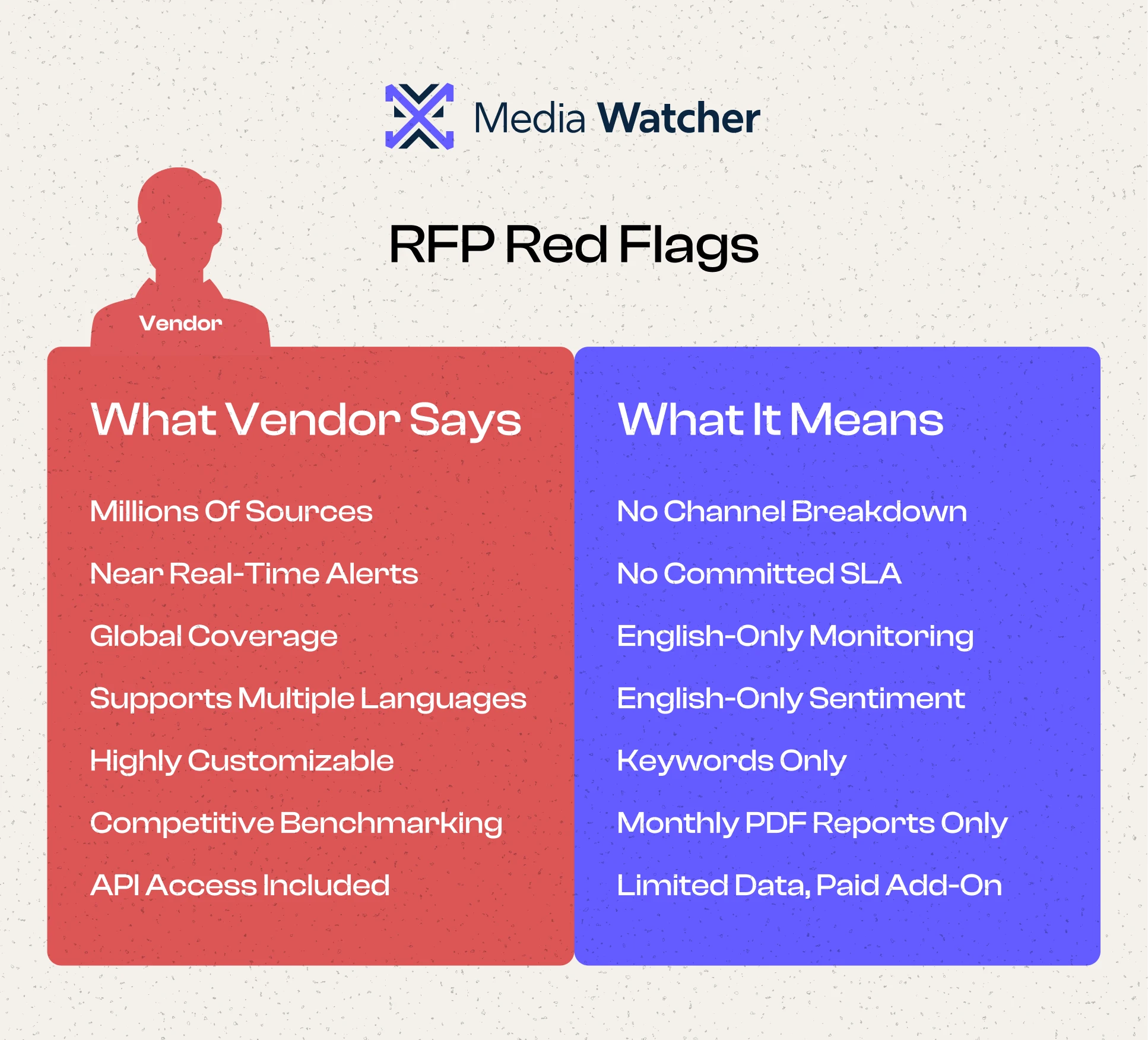
This is the foundation of any media monitoring RFP. Vendors should provide a specific, verifiable number across news outlets, social media platforms, broadcast, podcasts, and online forums. General or vague responses, such as millions of sources with no division, are considered a warning sign.
Ask vendors to separate their channel coverage by online news, print, social media, broadcast, podcast, and blogs. The most important channels are industry-specific.’
A financial services company focuses on wire services and financial news, whereas a consumer brand focuses on social media platforms like TikTok, Instagram, and YouTube.
What Is Your Geographic Coverage, And How Many Languages Do You Support?
For any organization operating across more than one market, geographic and language coverage is a critical factor in media monitoring vendor selection. Ask vendors to specify the regions and languages covered and confirm whether sentiment analysis is available across all languages or only in English.
A platform covering diverse regions and multiple languages performs very differently from one that monitors English-language news only and calls it global coverage.
What is Your Average Alert Delivery Time From Source Publication To User Notification?
Alert speed matters because the first 90 minutes of a news narrative are often the most important. Research from MIT has shown that early responses to breaking narratives significantly affect long-term perception outcomes.
When your team hears about a story two hours after it’s circulating, there is no longer a response window.
Ask vendors for a specific number. Not “near real-time.” Not “as fast as possible.” An agreed and contractually obligated number. Media alerts that are delivered within 200 milliseconds of publication on the source are in an entirely different category from the alerts delivered at a 15 or 30-minute frequency.
How Does Your Platform Handle Breaking News And Sudden Spikes In Coverage Volume?
Not all media crises grow slowly.
Some appear within minutes, driven by a single viral post, a court filing, or a leaked document. Ask vendors how their alert infrastructure scales during high-volume events and whether alerts can be filtered by sentiment, source type, region, or keyword combination to avoid burying your team in noise.
Can Your Alerts Be Customized By Keyword, Sentiment Shift, Topic Cluster, Or Source Type?
A system that floods your inbox with every mention of your brand name is nearly as useless as no monitoring at all. The value of a media monitoring platform is in surfacing the mentions that matter, specifically those showing a shift in tone, a spike in volume, or coverage from a tier-one outlet.
Ask vendors to demonstrate exactly how alert customization works, and whether sentiment-based triggers are available.
How Does Your Platform Handle Sentiment Accuracy For Non-English Languages?
Most platforms address sentiment analysis in English but not in Arabic, Japanese, Portuguese, or Indonesian.
If your brand operates in multilingual markets, ask vendors to take you on a tour of how they handle non-English sentiment accuracy, i.e., not merely to purport to work with other languages of the globe.
Which Social Media Platforms Do You Monitor, And How Deep Is Your Coverage On Each?
Ask the vendors to enumerate all social media they cover and to indicate the difference between tracking posts from the general community and a broader social environment. It includes threads, comments, posts using hashtags, and mentions of a third party.
At least the following coverage should be made: X (previously Twitter), Facebook, Instagram, TikTok, Reddit, and YouTube. In specialized industries, this coverage may also apply to Discord servers, Telegram channels, or even industry-specific forums.
Can Your Platform Benchmark Our Brand’s Media Coverage Against Competitors?
Competitive intelligence is one of the clearest use cases for a media monitoring platform. Ask vendors whether competitive benchmarking is available as a built-in feature, what metrics can be compared (share of voice, sentiment parity, coverage volume, source quality), and whether this is available in real time or only in periodic reports.
What Historical Data Do You Provide, And How Far Back Does Your Archive Go?
To benchmark and provide context, historical data is paramount to compliance teams, researchers, and organizations planning a new campaign or introducing a new product. Ask the vendors to define the extent of their archive dates, whether they include historical search, and what tools are provided to analyze long-term trend data.
What API Access Do You Provide, And What Can Be Done Through It?
Companies that use business intelligence platforms, CRM systems, or internal dashboards require a media monitoring platform that can push information to those systems. Ask vendors to make their API technical documentation available, clarify which data formats are offered, and check whether API access is included in standard licensing or sold separately.
How Media Watcher Answers These Questions
For communications and PR teams that are considering the media monitoring services, the above questions are what we consider as our own standards.
Media Watcher monitors more than 100,000 sources of news, social media, broadcast, podcasts, and online sources, and sends media alerts within less than 200 milliseconds of source publication.
In addition, sentiment analysis can support over 80 languages and 235+ geos, and scoring can be more than just the simple positive or negative.
Social listening is also available on Facebook, X, Reddit, YouTube, TikTok, Instagram, and LinkedIn, and the hashtag tracker is specifically designed for fast-moving viral events.
Media alerts are also keyword-customizable, sentiment-shift, source-type, and geo-region-specific, meaning your team will only receive alerts that are important.
For organisations running an RFP for a media monitoring platform, we would be pleased to provide a comprehensive response to your document and offer a live demonstration using your brand.
Book a call with our team, and we will walk you through exactly how Media Watcher performs against each of the 10 questions in the RFP template.