

With the modern digital-first setting, the brands, governments, and organizations in every field are experiencing increasing pressure to move fast, know better, and act smarter when it comes to the constantly changing customer sentiment.
Introduces sentiment analysis, a powerful tool that enables businesses to determine the emotional tone of content or spoken statements and better understand consumer or target audience opinions.
However, it’s a great idea to think that creating your own sentiment analysis model can be a viable solution, but there are huge hidden costs and difficulties that accompany such a solution.
Therefore, getting a ready-made sentiment analysis API is a smarter, more scalable option. Here’s why.
The Challenges of Building Your Own Sentiment Analysis Model
1. High Initial Costs and Maintenance Effort
A sentiment analysis model requires a dedicated team of data scientists, machine learning engineers, and developers. The initial cost is very high.
It is not only that you have to create a system that can accommodate a massive amount of data that you will be working with, but also that it has to constantly be upgraded to reflect changes in language trends, slang, and emotional expressions.
Moreover, continuous maintenance is another challenge. Words and public opinion are ever-changing; therefore, your solution should be updated and retrained on a model to remain relevant and accurate.
This translates to additional financing for testing, tuning, and refining the system.
Thus, without a ready-to-use sentiment analysis platform, your company will incur significant costs and time to develop a model that must be monitored and updated continuously, hindering your growth.
2. Time-Consuming to Scale
With business expansion, the volume of data the business needs to process will increase. Without an automated sentiment analysis tool, it can easily take a long time to analyze the tweets, reviews, or comments of hundreds or thousands of customers of a business.
Therefore, scaling will be quite infeasible in case a person is still using manual techniques or an outdated model.
Sentiment analysis involves handling a large scale of text in different platforms and mediums in real-time. This would require the brand or business to have bottlenecks and slower insights without an API to automate the activity, making it difficult to react to the changing trends in real-time.
And eventually, this may result in lost opportunities and delayed responses. Thus, it is easy to be caught in a wave when responding quickly to public sentiment, either ahead of it or lagging behind.
3. Inconsistent and Biased Results
Although sentiment analysis is supposed to be objective, human interpretations are subjective. An example of such a tweet is a sarcasm-heavy message that can be misinterpreted as positive.
When the team you are leading in business is working on a manually built model or based on a simplistic algorithm, without deep learning, the risk of non-consistent outcomes becomes high.
Essentially, a poor strategy decision may result from incorrectly classifying customer feedback or market sentiment, leading to the launch of the wrong product or misjudging a public relations crisis.
4. Difficult to Assess Complex Sentiments
A human emotional spectrum is vast, and emotions like sarcasm, irony, and mild frustration cannot be easily captured by simple algorithms. Sentiment analysis software that does not take these complexities into consideration can result in a situation where the sentiment is misclassified.
As an example, a sarcastic compliment may usually be taken at face value as a sincere positive feeling when, actually, it is an effort to hide discontent.
However, a modern sentiment analysis API is usually trained to respond to nuances of emotion, not just positive or negative feedback, but also complex emotions that are difficult to define.
Without the ability to interpret more complex emotional expressions, you are likely to miss important lessons that can be applied to enhance the customer experience, manage crises better, and perform marketing that is more focused.
5. Confined Real-Time Insights
It is all about timing in the era of viral social media posts and real-time reaction. Real-time sentiment analysis helps you understand what people think about important events in real time, whether it’s a new product, a celebrity brand, or a political crisis.
However, in the absence of a sentiment analysis API, you can probably only get delayed information, which implies that you are responding to the feedback when it is too late.
It can be very important in situations of high stakes, like a PR disaster or a social media craze.
Therefore, when you do not have real-time insight into people’s mindset toward your brand, product, or service, you are operating blindly when it comes to aligning with changes in how people think.
This will impact your brand, potentially resulting in lost marketing opportunities and a sluggish response to customer concerns.
6. Integration Challenges
One challenge with developing your own sentiment analysis model is integration. It is necessary that the model is compatible with your current tools and systems (CRM sites, social media monitoring software, customer service software, etc.).
The lack of integration can lead to data silos, where information on one platform cannot be accessed across the rest of your system.
Also, the process of sentiment data collection, analysis, and action cannot be streamlined without integration, and valuable insights could be lost or misunderstood.
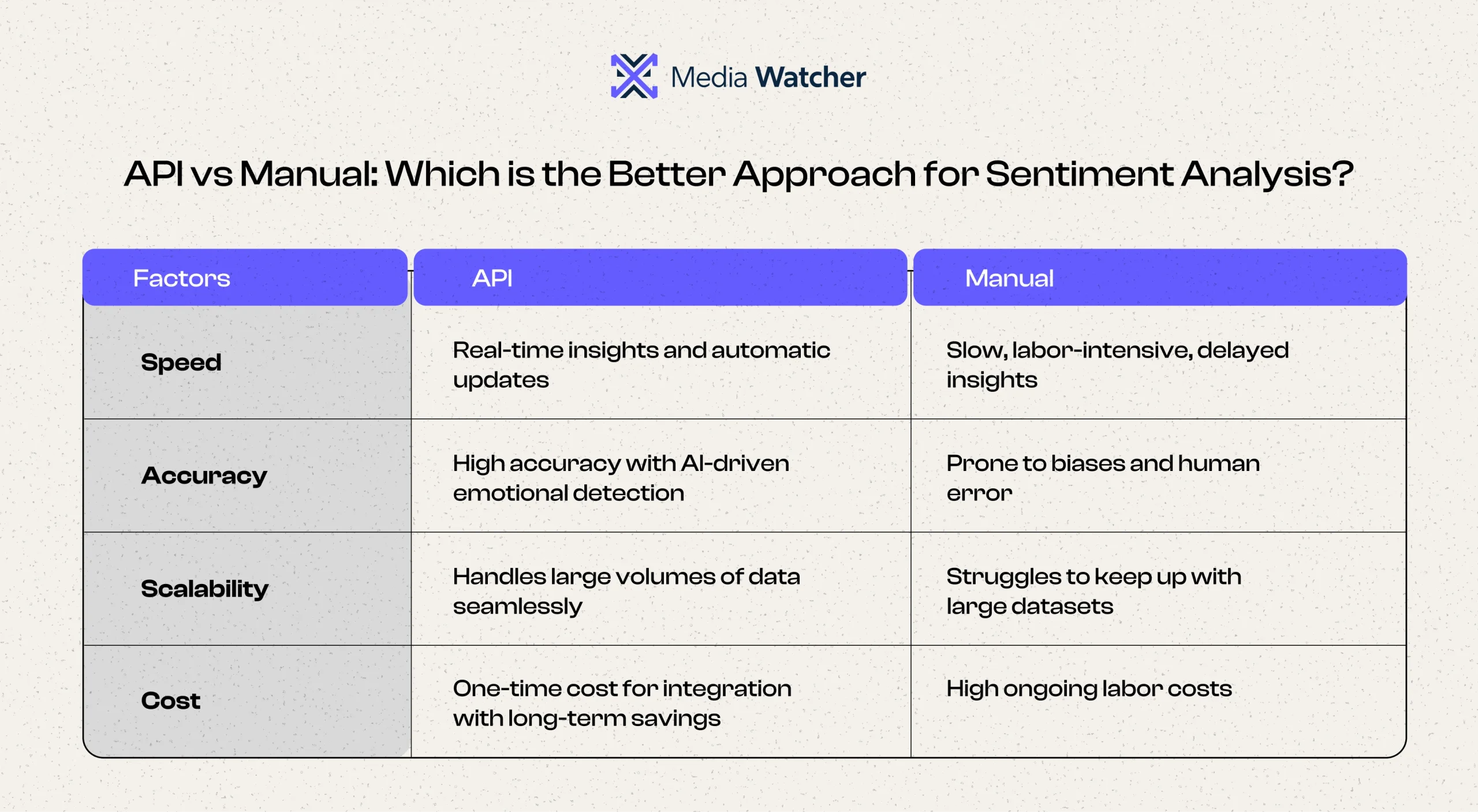
Integration of Sentiment Analysis API is the Smarter Choice – Why?
Rather than investing in developing your own sentiment analysis model, an existing sentiment analysis API is an easily integrated, economical solution that can address all the foregoing issues. Let’s take a closer look at a few of the benefits:
Save Time & Resources
The large development teams are unnecessary. Sentiment analysis API is a plug-and-play solution that is easy and fast to integrate with your existing tools.
Scalable & Real-Time
As your business grows, the API scales with you, providing real-time insights without the complexity of maintaining your own infrastructure.
Accurate, Complex Sentiment Detection
The API can correctly recognize complex emotions using machine learning and natural language processing. It manages all mixed feelings with regard to user-generated content.
Seamless Integration
The API can be integrated with other solutions, such as customer service solutions, social media monitoring tools, and CRMs, ensuring that your understanding is presented in the appropriate context and in real time.
Integrate Sentiment Analysis API of Media Watcher For Smarter Business Decisions
A self-built sentiment analysis model might seem to be a cost-efficient way to solve the problem on the surface, but the concealed expenses in the form of resources, maintenance, and accuracy can easily get out of hand.
The Sentiment Analysis API from Media Watcher provides an accurate, fast, and scalable out-of-the-box solution that will save you time, money, and strategic errors.
With real-time sentiment, you can think proactively rather than reactively and stay ahead of the curve on customer feedback, your products, and market trends.
Choose Media Watcher, and make smarter, data-driven decisions faster. Contact us or book a demo from the website today!
Frequently Asked Questions
What Is a Sentiment Analysis API?
A Sentiment Analysis API is a cloud-based solution powered by machine learning and natural language processing (NLP) that automatically interprets and evaluates the emotional tone within text. It analyzes written data and classifies sentiment as positive, negative, or neutral, enabling organizations to quickly understand opinions, reactions, and overall audience perception at scale.