

In 2026, media listening will not just be a matter of counting mentions or collecting screenshots. It is all about taking raw data and converting it into actionable intelligence, so teams can act quickly, understand changes in the conversation, and demonstrate value with proper evidence.
The media race today is extremely fast. With more than 5.66 billion users of social platforms, that is about 68.7% of the globe, it is true that people are talking about your brand everywhere and everywhere.
The sheer amount of volume implies that you need a way to cut through noise, expose meaningful signals, and make strategic decisions with confidence.
However, the opportunity is daunting when it comes to having an expanding market that is estimated to reach nearly $5.99 billion in 2026, and which is expected to continue growing at double-digit levels.
Here’s a guide that can help you choose how tools take you from signal to story to proof, not by feature checklists but on real impact.
Why the Old Playbook Doesn’t Work in 2026
Traditionally, teams chose monitoring tools by counting coverage sources or tallying how many posts were found. That was fine when the world was smaller, and conversations were linear.
Now, coverage spans traditional news, podcasts, broadcast, forums, blogs, and social platforms with multiple variants under one brand name. Thus, tools with simple keyword tracking generate a high volume of alerts. But what really matters is actionable insight, not noise.
Additionally, with AI and machine learning in analytics, tools can not only collect data but also help you interpret it.
Real‑time mood shifts, storylines, and visual mentions now join text signals in defining what’s important.
How to Evaluate Media Monitoring Tool – The Five Test Framework
Here’s a practical framework based on proper results, not checklists. Each of the following tests measures how well a tool helps your team generate actionable insights and produce defensible reporting.
1. Catching Conversations When They Matter
A monitoring tool’s first job is to see what’s emerging, not what already exploded yesterday, so real‑time detection matters. Today, people expect quick responses. A study shows that 73% of consumers are likely to switch to a competitor if a brand doesn’t reply fast on social media.
So before getting a tool, check:
- How quickly does it alert you about spikes or new topics?
- Does it detect pattern shifts or just mentions?
Because tools that only check hourly or batch data may miss early pumps, leaving teams without the chance to respond before stories go viral.
2. Filtering Out the Noise
This is where many tools trip up. With billions of conversations happening every minute, raw volume is useless without context. Strong noise control means:
- Recognizing typos and name variants,
- Filtering bots and irrelevant chatter,
- Accurately tagging brands, products, and trending themes.
Your evaluation should test the tools on unclear strings and phrases or overlapping names and measure the number of false positives they produce.
3. Narrative Clarity
After capturing a signal, the next step is to comprehend why it is important. Good tools now organize mentions into themes and proper stories that help answer these key questions.
- What sentiment is driving the trend?
- Which channels are amplifying it?
- Is the conversation growing or shrinking?
Therefore, it would make it easier to understand exactly what people are discussing and how discussions shift across sources.
Furthermore, a few platforms are currently applying AI clustering and narrative intelligence to map the diffusion of conversations going on across social and traditional media.
4. Proof and Compliance
It is obvious that continuous alerts and dashboards are helpful in meetings, but what do you do when your stakeholders need proof?
In high-risk sectors like Financial Tech and RegTech with strict regulations and critical compliance decisions, following rules and maintaining records are essential. Therefore, tools should provide:
- Licensed content and legal rights to archive
- Timestamped proofs for every alert
- Audit trails for analysis are shared internally
Monitoring becomes part of your evidence chain, not just a display of numbers. And as content grows more complex, this defensibility becomes a differentiator.
Suggested Read: A Complete Guide to Media Monitoring for Compliance and Regulatory Teams
5. Workflow Integration
As useful as insights can be, they’re worthless if they don’t integrate with your daily workflows, alerting systems, or reporting cadences.
Look for tools that have the following:
- Can we send alerts directly to operations workflows?
- Can the tool connect easily with the systems you already use?
- Does it export reports in formats your stakeholders need?
In essence, value comes when data seamlessly becomes part of how your team works, and not an extra task.
What Research Tells Us
The media monitoring sector continues strong growth, reflecting rising demand for real‑time brand and reputation intelligence. Estimates suggest the industry will cross around $5.86 billion in 2025, with forecasts showing strong expansion towards $20 billion by 2035.
Approximately 60% of media monitoring activity is currently allocated to social monitoring, driven by the need to track discussions on platforms where people are most active.
Beyond pure volume, brands are spending on tools that provide a greater understanding of audience behavior. With billions of users on social media, brands can no longer afford to ignore digital conversations.
Meanwhile, advertising spend on social channels remains huge, with projections near $277 billion in global ad spend for 2025, showing continued prioritization of social engagement.
These macro trends demonstrate that media monitoring solutions are currently at the intersection of reputation, engagement, and competitive intelligence.
A Practical 7‑Day Pilot for Selecting The Right Media Monitoring Tools
Here’s a hands‑on approach to evaluate contenders before investing:
- Day 1: Set up keywords with common typos and variations.
- Day 2: Test real‑time alerts by tracking a known trending topic.
- Day 3: Evaluate semantic clarity and see whether the tool explains context.
- Day 4: Check sentiment accuracy, especially with mentions.
- Day 5: Analyze narrative clustering, comparing automated themes vs manual observation.
- Day 6: Export reports and verify evidentiary completeness.
- Day 7: Trial integration with workflows and stakeholder sharing.
Machine learning and AI have arguably made leaps in this space. If a tool can consistently help you pass these seven days with clarity and defensible outcomes, it’s worth deeper consideration.
What are the Red Flags One Should be Aware of
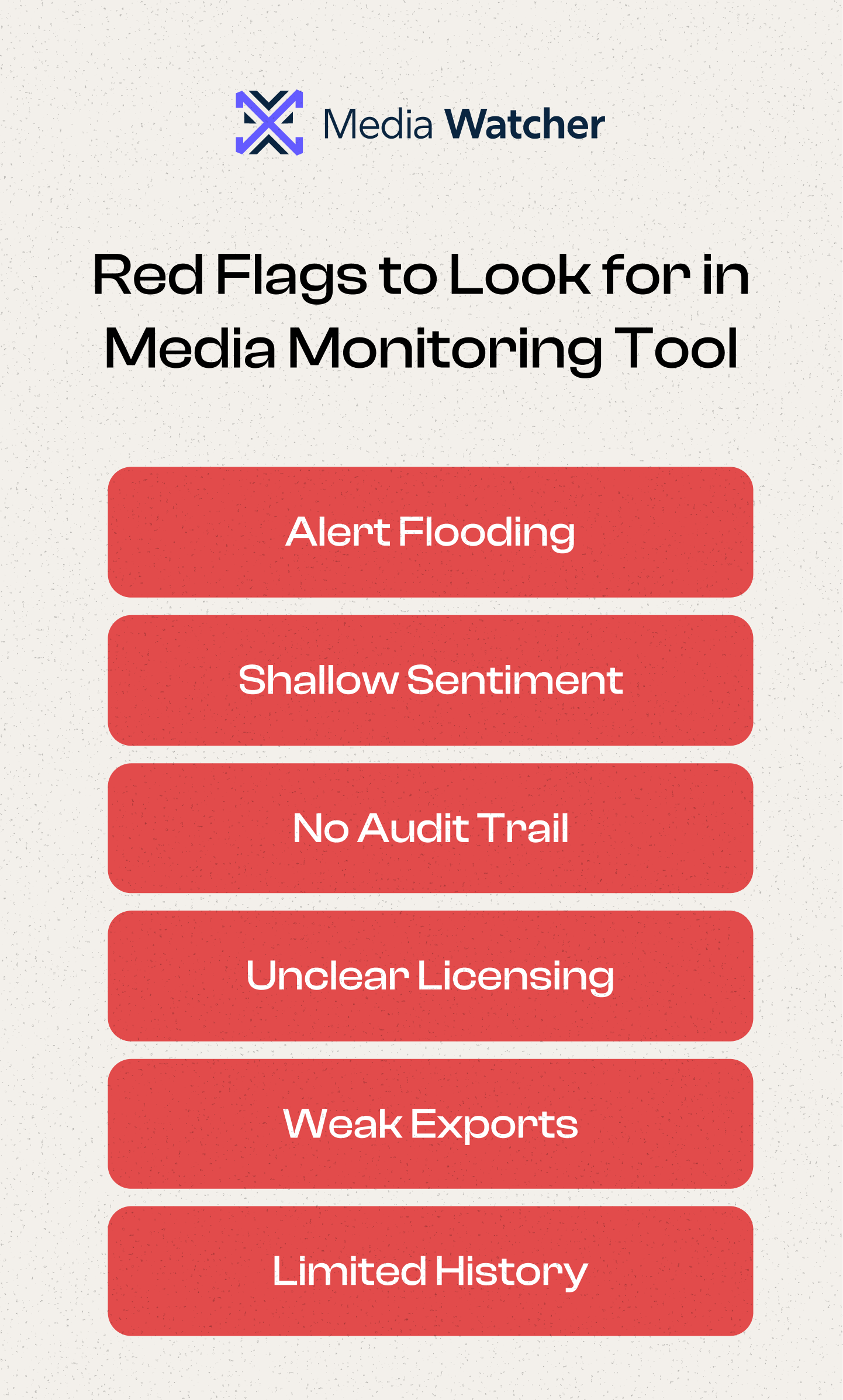
Some shiny dashboards still aren’t worth the cost. Be wary if:
- There is no context or prioritization of alerts.
- Sentiment scores are crude and binary.
- Historical information is restricted or is difficult to export.
- Licensing or compliance rights are unclear.
One should be aware that fancy visuals are not the same as strategic insight.
Suggested Read: Explore Media Monitoring Cost, Plans, and Important Factors
Media Monitoring That Moves You from Mentions to Momentum
By 2026 and further years, selection of a media monitoring platform will be more about impact measurement, and not merely counting mentions.
Therefore, the appropriate solution can assist teams to act promptly, explain sense, and support choices with defensible data.
In the future, brands will need a smart partner to streamline their processes, minimize noise, and connect to strategic deliverables. And that is the actual change of value in this new decade of media insight.
Why Choose Media Watcher
By taking into consideration signal speed, noise control, narrative clarity, proof readiness, and fit of workflow, you are asking a lot, and most legacy platforms fail to meet the criteria.
Media Watcher’s media monitoring solution was designed based on these principles. It goes beyond mentions, uncovers narrative drive, and provides clear context for why conversations are changing.
The tool reveals actionable insights based on user-generated content available on the internet that you can rely on.
Moreover, by using customized notifications, licensed archive evidence, and communication- and reputation-specific reporting, it transforms raw media data into actionable intelligence usable across your entire company.
Use the five tests above as your evaluation guide, and when you’re ready, test Media Watcher to see how quickly you can move from signal to story to proof in your next major campaign.
Book a demo or contact our website.