



The decision of the European Union to withhold a significant trade agreement with the United States has divided the masses quickly. Some interpret it as an overdue form of opposition to tariff threats and Greenland rhetoric by President Trump. Others consider it a dangerous escalation that may hurt the already fragile transatlantic relationship. Online, the discussion is emotional, more concerned with trust, sovereignty, and economic anxiety than with trade clauses and policy language.
What Media Watcher’s Media Monitoring Insights Reveal About the EU–US Trade Standoff
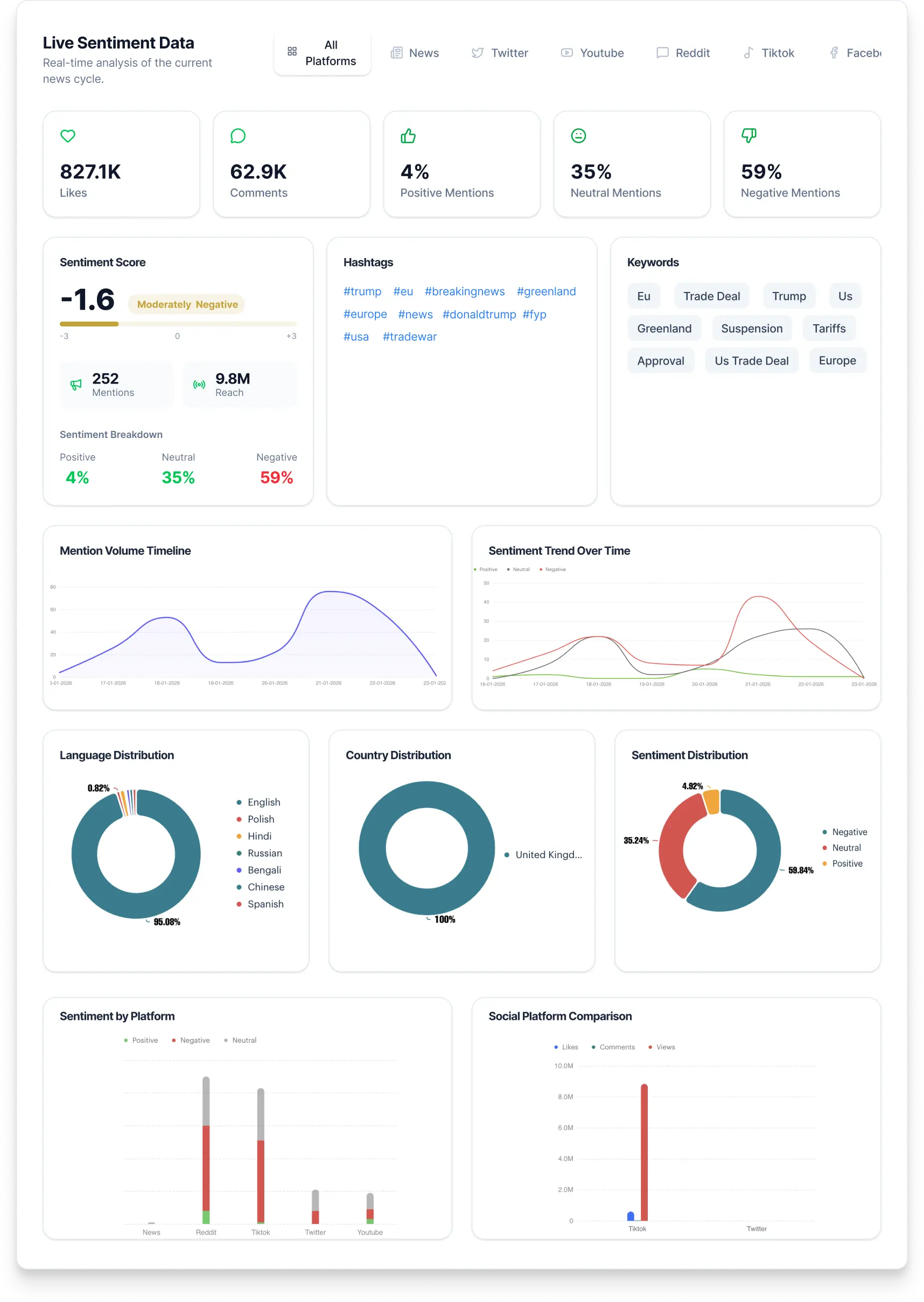
Media Watcher insights indicate a sentiment score of -1.6, which puts public reaction precisely in the moderately negative range. Among the 252 mentions tracked, notably, 59% are negative, 4% are positive, and 35% stay neutral. Such an imbalance is an indicator of frustration over optimism.
A EU-US trade standoff announcement has a high level of engagement, with 827.1K likes, 62.9K comments, and an estimated 9.8M reach, which implies that the issue has left policy circles and entered the mainstream debate. The statistics indicate that anger and uncertainty are driving individuals to raise their voices rather than seeking approval.
The conversation clusters are predetermined by keywords such as EU, Trump, Greenland, Tariffs, Suspension, and US Trade Deal. The use of hashtags like trump, eu and Greenland indicates that the subject is not being discussed in economic terms but rather in political terms. On a platform scale, TikTok leads the volume of discussion, indicating that it suggests younger audiences respond emotionally to the headline-level stories and not the implications of technical trade.
The United Kingdom has the highest regional concentration of 100% discussion, with English spoken by about 99% of the population. This focus can imply that the audiences in the UK are viewing the story as a European power movement as well as an indicator of wider Western instability.
Why the Halted EU–US Trade Deal is Polarizing Supporters and Critics
Proponents of the EU action, particularly in the UK and on the Western European side, view the suspension as a sovereignty issue. To them, threats of tariffs by Trump associated with Greenland are coercive. High negative sentiment by Media Watcher is not only about tariffs but also the fear of precedent.
Critics, though, are concerned about the economic repercussions. Business-oriented voices and trade commentators in the United Kingdom believe that hindering conversation can lead to increased cost, declining exports, and another hit to the global market confidence. The presence of neutral sentiment pockets implies that a large number of people are torn between political pride and economic realism.
Why Trump’s Trade Rhetoric is Shaping Europe’s Trust Gap
The response is inseparable from the larger trade position of Trump. The perception of US intentions in Europe has changed under the influence of tariffs, territorial rhetoric, and transactional diplomacy. The very fact that Greenland is mentioned evokes greater fears of power imbalance, and any technical trade hold-ups become symbolic, as this is a reaction to tone rather than policy in the mind of the public.
The response of the public to the US-EU trade freeze indicates how fast the mood differs in different regions and platforms. Media Watcher can help teams track these changes in real-time, contrast sentiment by platform, and recognize regional variances before the narrative solidifies. Effective decision-making on the basis of informed policy requires accurate sentiment intelligence in order to engage the global discourse in policy-driven discussions.
Suggested Read:
European Union and U.S. at Odds Over Visa Bans and Digital Regulation
Hungary’s Pride Parade Ban Triggers Nationwide Debate on LGBTQ Rights