



The recent move by the U.S. State Department to suspend the processing of immigrant visas by citizens of 75 nations, which is to be enforced on January 21, 2026, has caused a heated controversy. Although the move has been suggested by a wider reevaluation of immigration regulations, it is crucial to mention that the policy is the result of initiatives undertaken during the Trump regime, namely the increase of the public charge rule, which evaluates the likelihood of an applicant relying on the assistance of the government. Supporters argue that the policy is a necessary step toward controlling immigration and ensuring that applicants can sustain themselves without public assistance. However, critics warn that the suspension will harm families, disrupt lives, and exacerbate immigration challenges.
What Media Watcher Reveals About the U.S. Immigration Visa Pause?
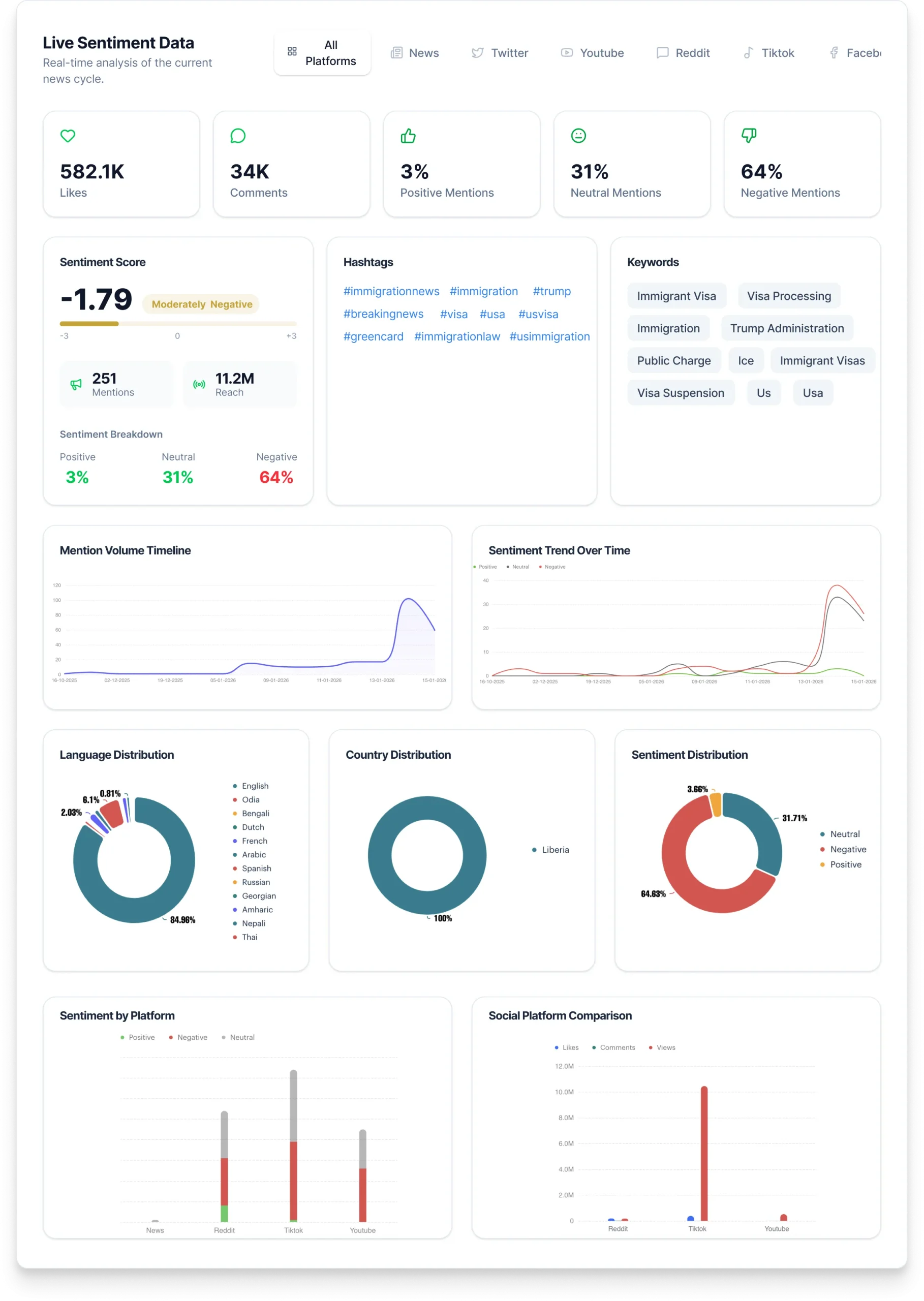
The media monitoring insights by Media Watcher on the U.S. immigrant visa pause demonstrate how polarizing and emotional this policy change has become. The sentiment score of -1.79 indicates that the public is not just neutral in its response, and the majority of mentions (64%) are negative. It is indicative of the general public outrage and disappointment over the ruling, especially within immigrant advocacy organizations and families that worry about the long-term consequences to family reunification.
In states such as California and New York, where the policy has come under scrutiny, the negative sentiments have increased, as critics perceive the pause to be a regressive part of American immigration history. Terms such as family separation and unfair targeting are prevalent on social media platforms, highlighting the personal cost the policy has on the families. Meanwhile, positive mentions are only 3%, mostly originating among conservative circles, such as former President Donald Trump and Texas lawmakers, who believe that the measure is needed to regulate immigration and save local resources.
The 31% of neutral mentions are an extension of the population that is caught between pro and anti, being either unaware of the implications of the policy or having resigned to the political facts of immigration reform. The implication of this neutral group is a bigger disillusionment with the intricacy and apparent intransparency of the immigration system.
Regarding the level of public participation, the volume of discourse reached to the point of 11.2 million mentions on social media. X (formerly Twitter), Reddit, and YouTube had the majority of the attention. As Reddit and X (formerly Twitter) are the arenas of more vocal support and opposition, YouTube offered a more balanced platform, where a broader spectrum of perspectives is exchanged. It demonstrates how various platforms influence the color and the heat of the public debate, as Reddit and Twitter promote polarized discussion and YouTube provides space to a wider variety of voices.
A striking finding in the regional analysis is the overwhelming dominance of Liberia in the conversation, accounting for 100% of the mentions regarding immigrants visa ban. The mood in Liberia is largely negative, fueled by personal experience of inconvenience, loss, and keeping families together. This policy seems to many like a stinging fence to the American dream, and a direct challenge to their ability to reunite with loved ones across the borders.
Why the Public Charge Rule is Dividing Opinions on Immigration?
At the core of this policy lies the public charge rule that evaluates the likelihood of an immigrant being dependent on state-level assistance. According to the rule, the U.S. government considers whether a person will become a public charge, or a person who will rely on government assistance. This regulation, as several critics claim, has a disproportionate impact on low-income families and those originating from the less-resourceful countries. Some consider it an unavoidable instrument to regulate immigration and government expenditure, but others perceive it as a form of punishment that unfairly targets disadvantaged groups.
Given the intricacy of the current controversy surrounding the U.S. immigration visa suspension, it is crucial to understand how sentiment is formed and diffused. Media Watcher facilitates that transparency by monitoring sentiment change in real-time, examining reactions by region and platform, and offering insights based on cultural and political background. Instead of relying on surface-level impressions, teams can understand where opinions are solidifying, where they remain undecided, and how different audiences engage across social channels and news outlets.