



The debate over immigration in Australia is raging, as the opposition Coalition is offering drastic reductions to the number of international students and skilled migrants. Proponents cast the relocation as long-awaited relief against housing stress and infrastructure overload. Critics regard it as economic self-sabotage that jeopardizes universities, employers, and the image of Australia around the world. On digital platforms, the debate is framed as a choice between cost-of-living anxiety and long-term growth fears, as the immigration debate becomes a proxy war over the type of country Australia wants to become.
What Media Watcher’s Media Monitoring Insights Reveal About Australia’s Immigration Cuts Debate?
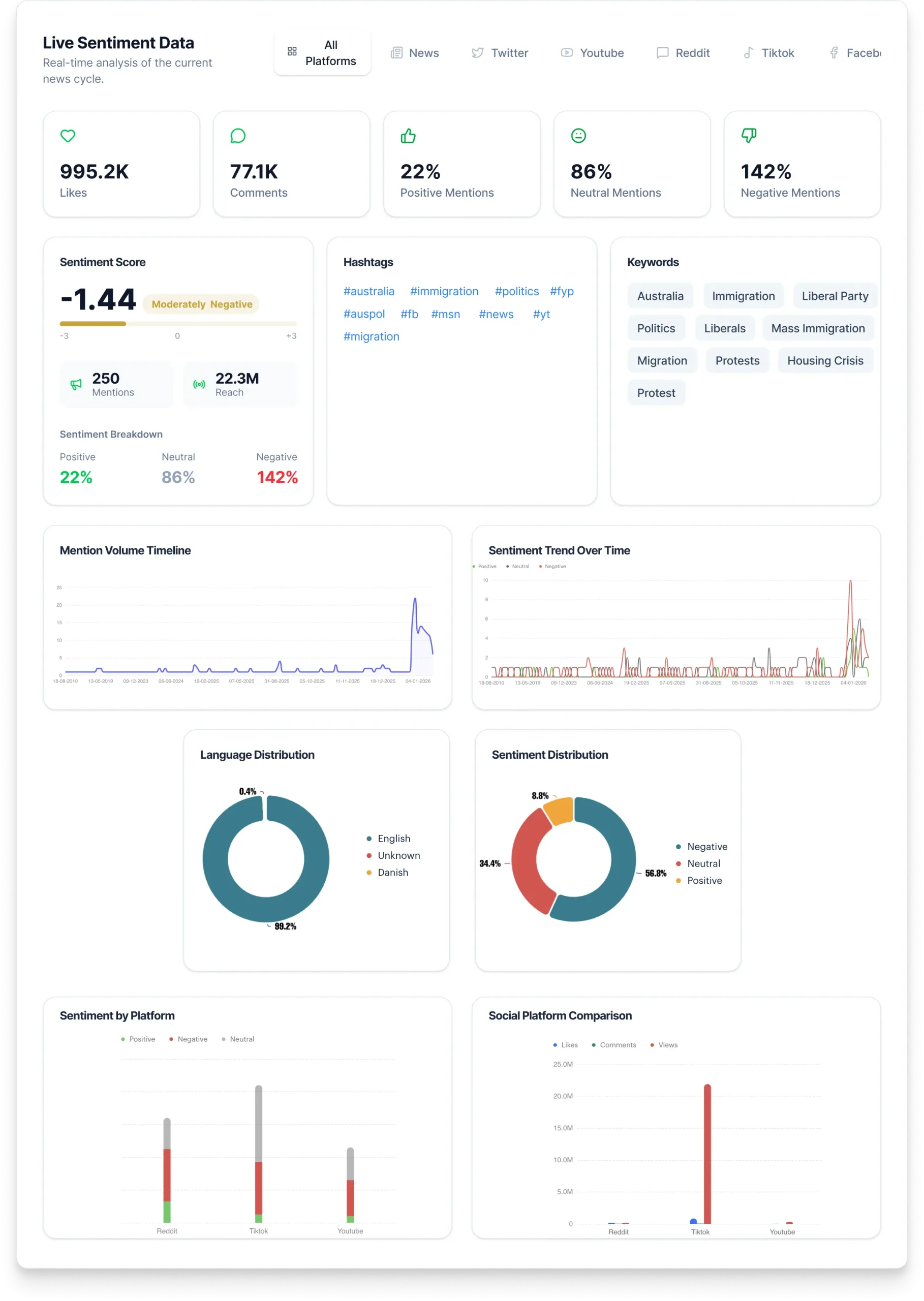
The sentiment score of -1.44 on Media Watcher’s media monitoring dashboard places public reaction in moderately negative territory. The conversation is intense and emotional, with a total of 995.2K likes, 77.1K comments, and a reach of 22.3 million, despite the volume being tracked at 250 mentions. Such an imbalance implies that fewer posts are generating disproportional engagement.
The sentiment breakdown is a clear narrative of discomfort, where negative sentiment reigns with 142% and neutral at 86% and positive at only 22%. This evidence indicates a need to be more critical than constructive, with most posts showing frustration, but not policy curiosity.
Platform behaviour provides an additional dimension. TikTok indicates the largest spikes, specifically under negative and neutral reactions, showing that the issue has a strong resonance with younger audiences and renters. The content is more analytical on Reddit, and there are longer threads discussing housing supply and migration limits. YouTube sits in between, reflecting media-driven narratives rather than grassroots mobilization.
Hashtags like #australia, #immigration, #auspol, #politics, and #housingcrisis spike as do liberal party, mass immigration, protests, and housing. The majority of the language distribution is still overpowering English (98.2%), which further supports the claim that debate is mostly domestic and voter-centered.
Two Sides of the Australian Immigration Debate: Cost-of-Living Fears and Labour Shortages
Conservative voters, One Nation supporters, and parts of the Liberal Party base, particularly in cities such as Sydney and Melbourne, are the main proponents of the proposed cuts. To most people in these groups, immigration is directly related to high rental rates, congested social services, and the daily strain of costs. International students and newcomers are commonly perceived as contributing to an already tense situation, and this frustration manifests in online discussions.
The plan is opposed by universities, employer groups, healthcare providers, and migrant communities. These organizations warn that the reduction of international students and skilled labourers is likely to exacerbate labour gaps and damage the local economies. The proposal is out of sync with actual workforce requirements in states that rely on students abroad, healthcare professionals, and technical expertise. The regional data provided by Media Watcher indicates more negative responses in regions where education and other vital services depend on migrant labour.
Why is Australian Immigration Becoming a Political Signal Ahead of the Election?
Immigration is being discussed alongside several other political pressures. Prime Minister Anthony Albanese’s criticism of the Coalition, Pauline Hanson’s warnings about housing pressure, and visible tensions inside the Liberal Party all influence how the issue is being understood. As the next election draws closer, immigration is discussed less as a policy setting and more as a signal of leadership, control, and direction. This shift explains why public reactions feel sharper and more emotionally charged than in previous cycles.
Against that backdrop, understanding how sentiment forms and spreads becomes essential rather than optional. Media Watcher supports that transparency by tracing sentiment shifts in real time, dissecting responses by region and platform, refining discussions with reference to cultural and political contexts. Rather than relying on headline impressions, teams can identify where opinion is solidifying, where it remains undecided, and how various audiences respond on social channels and in news coverage.
Suggested Read:
NSW Gun and Protest Laws Trigger Mixed Reactions from Citizens Statewide
Pacific Leaders Back Taiwan Participation Despite China’s Strong Pressure