

The world is projected to generate more than 180 zettabytes of data by 2025, but Gartner estimates that inadequate data quality costs organizations an average of 12.9 million dollars a year. Even with this massive amount of data, a majority of businesses cannot turn it into actionable decisions.
The insights are obscured instead of being displayed in spreadsheets, dashboards, and scattered reports. Business intelligence helps eliminate this gap, converting raw and unstructured data into insights that can be used to drive strategy, reduce risk, and enhance performance. Business intelligence enables organizations to make decisions with confidence rather than by guesswork, integrating both the company metrics and the external indicators, such as media coverage and market trends.
What is Business Intelligence?
Business Intelligence (BI) is the method of gathering, analyzing, and interpreting data to make informed decisions. It assists organizations in recognizing what is going on in operations, markets, and audiences based on data rather than suppositions. Instead of using an inconsistent flow of reports or guesswork, business intelligence introduces order and transparency to unstructured data.
In the simplest terms, business intelligence transforms raw data into valuable information. This understanding assists in tracking trends, gauging performance, identifying risks in their initial stages, and making strategic decisions. Contemporary business intelligence extends beyond internal information, such as sales or operations, with the assistance of media monitoring software. It also encompasses external indicators like media coverage, social sentiment, and narratives of the market, forming a larger view of the environment.
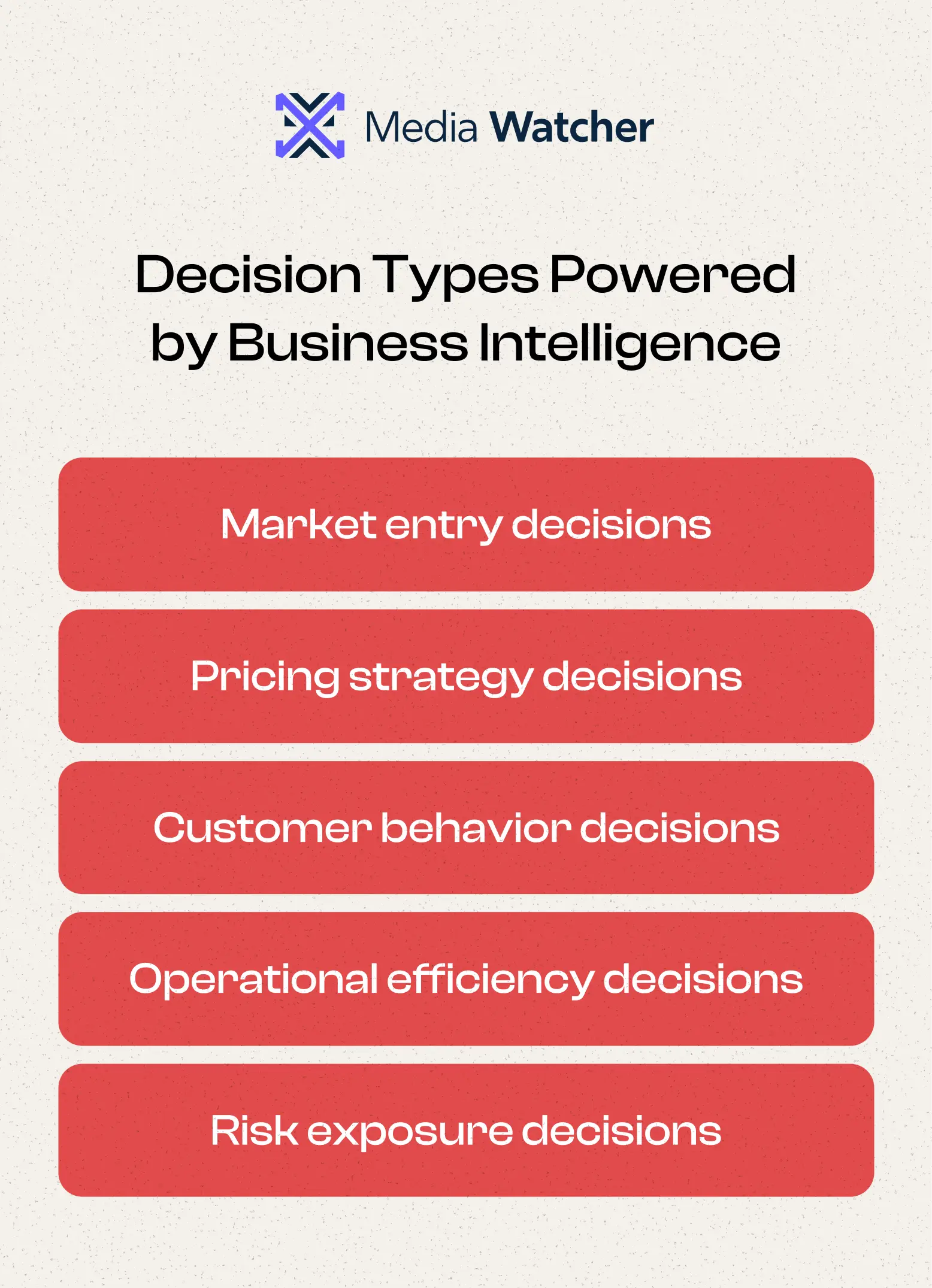
This expanded perspective is particularly useful when making decisions that require the perception of information outside internal systems. The following are some examples of how business intelligence can be used in real life:
Policy and Public Response Monitoring
Reactions to a new regulation or government decision can be quite uneven, depending on the region and even platform. The BI can monitor real-time media reporting and sentiment changes, enabling the decision-makers to see where the narratives become negative or positive. This enables communication adjustments to be made on time and actively engage instead of responding to situations proactively.
Reputation and Market Perception Analysis
Public perception is likely to shift quickly during corporate announcements or in times of crisis. Business intelligence converts media and popular discussion into operationalized insights and demonstrates how viewers react, where anxieties arise, and how emotion changes. Such insights help make informed decisions based on the real-world perception rather than guesses.

Major Types of Business Intelligence
BI encompasses various methods, each of which addresses a diverse decision-making requirement. Knowing these kinds enables organizations to select appropriate approaches towards their objectives:
Descriptive Business Intelligence
This type of BI revolves around the comprehension of the past and present performance. It replies to the questions of what has already happened or what is happening. Descriptive business intelligence includes dashboards, summary reports, and visual metrics. It is used to track performance trends, monitor KPIs, and understand past patterns by organizations. Although it does not describe the reasons behind the changes, it presents a clear picture of the situation.
Diagnostic Business Intelligence
Diagnostic business intelligence takes a step further to understand why something went in a particular way. It explores connections between data points to identify factors leading to alterations in performance or abnormalities. Such as, an abrupt increase in negative media coverage can be examined in conjunction with regional data to establish the cause of concern. This method assists decision-makers in transitioning between observation and comprehension.
Predictive Business Intelligence
Predictive business intelligence predicts future events by using past data and trends. It assists in the prediction of trends, risks, and emerging opportunities. Predictive insights can also warn about impending sentiment changes in media and reputation contexts before they escalate into common problems. This helps with planning ahead as opposed to a reactive approach.
Prescriptive Business Intelligence
Prescriptive business intelligence is about suggested actions. It integrates the insights of the other types to propose the most productive subsequent actions. Through the assessment of various situations, organizations are better equipped to know what to do in case of risk, how to maximize strategies, or how to allocate resources.
How Business Intelligence Solutions Actually Work?
Since organizations are subjected to quicker market shifts and increasing streams of information, isolated reports are no longer useful in making sound decisions. Contemporary business intelligence systems bring in a systematic methodology that links fragmented inputs to an understandable decision map. Teams no longer perceive performance, risk, and opportunity in a fragmented manner but through a consistent lens.
This working framework is based on the sequencing of related steps, all of which are meant to bring information nearer to action. These are given below for better comprehension:
Information Sourcing and Consolidation
The process starts with inputs collected both internally and externally. It all goes to a centralized setting, in the form of financial systems, operational platforms, customer data, and information exchanged with external sources like media coverage. The business intelligence tools are important here as they integrate these inputs and make sure that information is accessible, consistent, and interpretable.
Quality Control and Standardization
Information needs to be refined before meaningful interpretation can be done. This phase entails eliminating discrepancies, rectifying mistakes, and harmonizing formats between sources. Clean and standardized inputs minimize noise, provide better accuracy, and enhance confidence in downstream insights.
Analytical Evaluation of Patterns
Upon preparation, business intelligence analysis studies connections, patterns, and variations among datasets. This analysis assists in identifying potential red flags, performance changes, or risk development. Patterns start showing the story behind the change rather than random figures.
Insight Development for Strategic Use
Actionable business insights are created through analysis. These understandings relate evidence to context, enabling decision-makers to perceive implications instead of raw metrics. Communication strategy, prioritization, and operational response are guided by clear insights.
Visual Reporting and Accessibility
In the last step, a business intelligence reporting tool displays insights with the help of dashboards, summaries, and alerts. Visual clarity makes complex findings easy to interpret, and thus, action can be taken confidently and on time across leadership teams.
Role of Business Intelligence Analysts in Decision Making
The insight is not made by technology. The importance of interpretation is paramount.
A business intelligence analyst fills the gap between strategic decisions and data systems. This role entails posing the appropriate questions, confirming patterns, and converting findings into constructive recommendations.
Dashboards are interpreted and anomalies investigated by analysts, linking data trends to real-world occurrences. They allow the leadership to know not only what changed, but why it changed and what will happen next.
Analysts have a significant role to play in early detection within fast-moving environments. Negative coverage spikes, changes in sentiment among the audience, or gaps in perception across regions are usually urgent issues that need to be addressed as soon as possible. Analysts make sure that these signals are not lurking within datasets.
The role of the analyst is shifting towards strategic interpretation, not manual reporting, as business intelligence software advances.
How Media Watcher Strengthens Business Intelligence?
Business intelligence becomes more effective when internal data connects with real-world perception. Decisions today depend not only on performance metrics but also on how narratives form, spread, and evolve across regions and platforms. Media Watcher adds this missing layer by transforming media and public discourse into decision-ready intelligence.
By delivering timely context alongside data, Media Watcher helps organizations move from delayed reaction to informed response. The result is a clearer understanding, faster alignment, and stronger confidence in strategic decisions. Media Watcher supports business intelligence by through their media intelligence solutions as per the following:
- Tracking real-time media coverage and sentiment shifts across global and regional sources
- Identifying sudden volume spikes and narrative changes that signal emerging risks or opportunities
- Mapping sentiment differences across platforms, regions, and languages for deeper context
- Delivering actionable alerts and insights that integrate seamlessly into decision workflows
Contact the Media Watcher team to book a demo today.