



The second Trump administration has already started implementing regulatory changes that are rapidly gaining influence on the public debate. Proponents view an attempt to reduce what they term unwarranted supervision, with fewer regulations, less enforcement, and quicker business results. Critics interpret the same actions as a red flag, citing weaker consumer protections, increased uncertainty over discrimination protections, and the erosion of long-standing norms. The response on the internet has been fast and divided, with deregulation being either viewed as economic freedom or as a growing risk.
What Media Watcher’s Sentiment Data Reveals About Trump’s Second Term Regulatory Changes?
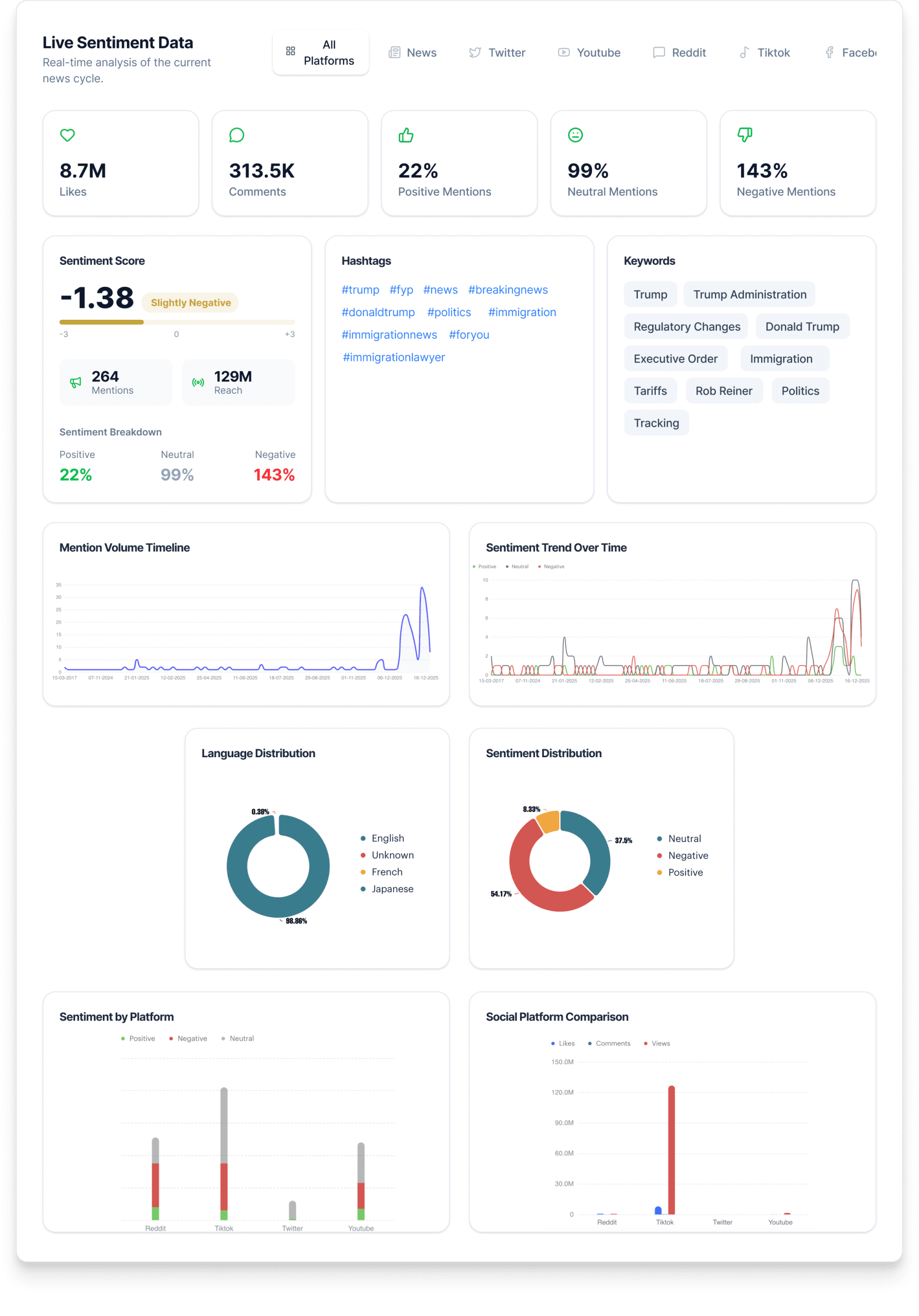
The Media Watcher’s media monitoring insights clearly capture the tension surrounding Trump’s Second Regulatory changes. The total sentiment score stands at -1.38, and the public response is slightly negative. Out of 264% of total mentions, 54% are negative, 37% neutral, and only 8% positive. The dashboard shows high engagement with 8.7 million likes and 313.5K comments, but approval is not synonymous with attention.
High interaction paired with negative sentiment often signals controversy rather than consensus. The media data suggests people are talking intensely, not comfortably. Reach tells another part of the story with 129 million potential reach; these regulatory changes are not confined to policy circles. Hashtags like #trump, #immigration, #breakingnews, and #immigrationlawyer reveal where concern concentrates. Immigration and executive authority repeatedly spike alongside regulatory keywords, suggesting audiences are connecting deregulation with underlying power structures.
Keyword frequency around “executive order,” “tariffs,” and “tracking” also reveals anxiety about speed. This spike suggests unease with how quickly policy direction may shift, especially in trade and international relations. The Media Watcher’s metrics show disagreement and uncertainty, with neutral mentions forming a large middle that appears watchful rather than convinced.
Trump’s Second-Term Regulatory Changes Seen as Economic Relief or Public Risk
The reaction to Trump’s second-term policy changes is partisan, cultural values, and economic pressure. The changes are framed as common sense by pro-deregulation voices, most of whom are business owners, conservative commentators, and deregulation advocates. In their view, agencies like CFPB had been too aggressive in hindering credit markets and adding strain on sectors of auto finance and public health. In this view, less enforcement means breathing can re-enter the sphere of innovation.
Consumer advocates, civil rights groups, and policy professionals, on the other side, interpret the same indicators as red flags. In some way, regulatory rollbacks are personalized to communities that are already sensitive to discrimination in the lending sector, public health access, or immigration enforcement. It is not an abstract fear; it is of fewer guardrails, less accountability, and unequal effect across vulnerable groups.
Responses among people vary depending on their location and profession. Financial and healthcare hubs respond differently from grassroots advocacy spaces. Meanwhile, communities that pay attention to immigration deepen the alarms, linking regulatory signals to experience. What comes out is not a straightforward pro or anti-Trump story, but a conflict between economic optimism and social risk consciousness.
How do Economic Pressure and Public Trust Affect the Response of Communities?
Regulatory policy has long served as an emotionally charged stand-in for deeper questions about protection, benefit, and risk.
The deregulation focus of the second Trump administration is similar to that of previous policies, but it arrives at a new time, conditioned by inflation fatigue, international trade conflict, and greater sensitivity to institutional power.
International pressure comes with tariffs and trade changes, whereas domestic rollbacks take the arguments of the first term, repackaged in the realities of the post-pandemic world. Enforcement slowdowns may reduce compliance costs, but they also test public trust. In the present times, where governance transparency concerns as much as outcomes, the perception of the people matters more than policy text.
The revealing conversations are resistance, support, and public recalibrating of expectations, wondering what deregulation means this time, and for whom.
Public debates rarely split cleanly, and this case shows why surface sentiment is insufficient. Media Watcher helps reveal the primary reasons for reactions, tracking contrasts between allies and commentators, mapping sentiment by region, platform, culture, and sending real-time alerts when the opinion of the populace changes. From executive orders to immigration policy, Media Watcher filters noise, highlights meaningful spikes, and captures nuance at scale when public opinion fractures; comprehending the divide becomes an advantage.