

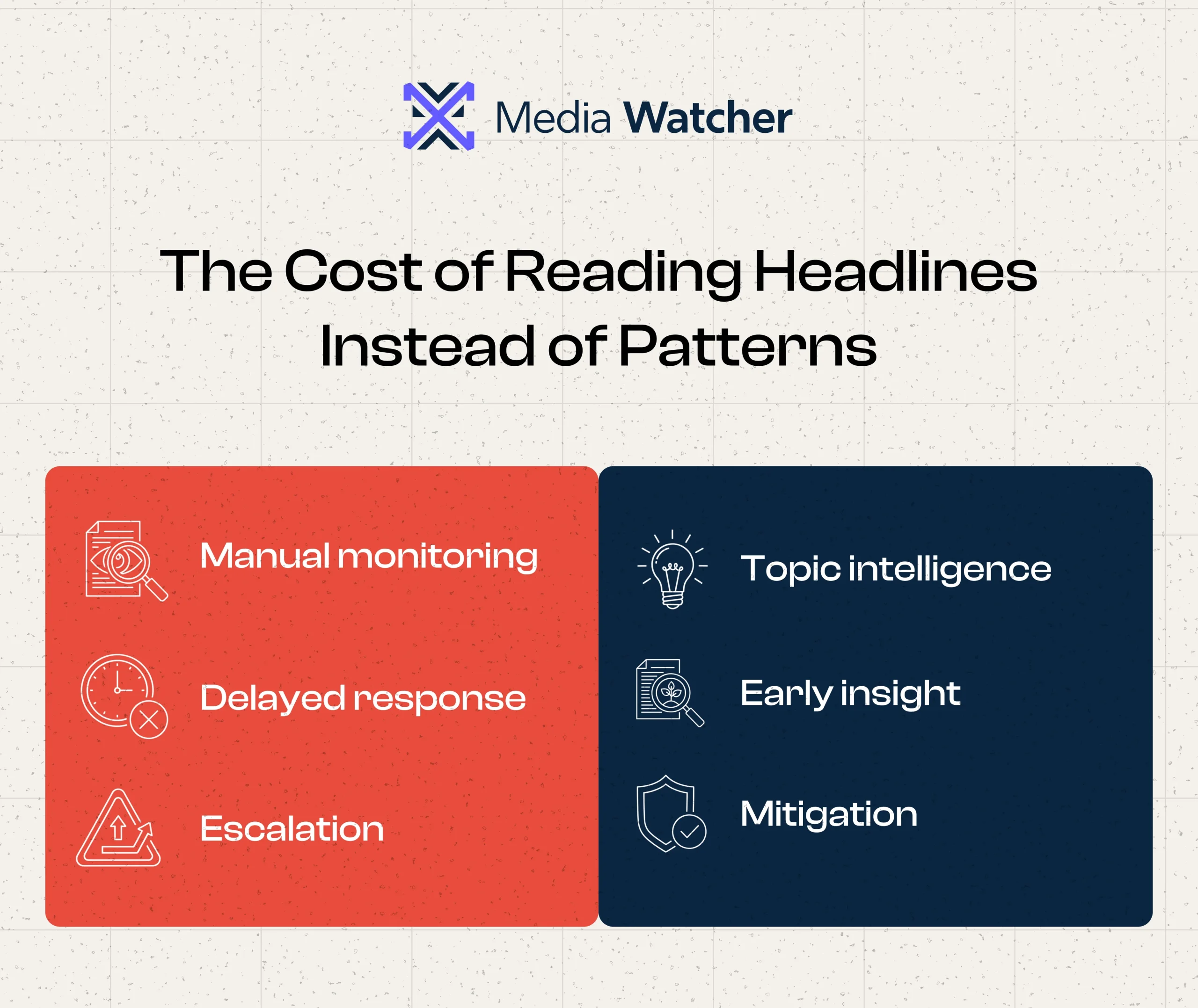
Why do certain news stories make headlines for a few weeks and disappear overnight? The solution in most cases is underneath the coverage, concealed within repetitive themes and patterns across media coverage. Topic analysis helps reveal the patterns behind what really matters.
A study conducted by McKinsey revealed that data-based organizations are more likely to gain customers by 23% and retain them for longer periods. However, even now, many teams use manual reading and their gut feeling to comprehend what is important in the news.
It is where topic analysis becomes essential. It allows teams to see clearly what is rising, developing, or declining in the media channels and through these channels without having to go through hundreds of articles, reports, and posts.
What is Topic Analysis?
Topic Analysis refers to the procedure of uncovering common themes in extensive text data, including news articles, social postings, blogs, and reports.
The approach does not look at individual mentions, but rather the patterns. It classifies similar keywords, phrases, and ideas in order to demonstrate what conversations are indeed about. As an example, one news item might touch on regulation, concerns of the people, and industry reaction. These signals are linked together into a single, clear narrative through topic analysis.
In simple words, topic monitoring software assists in transforming unorganized information into organic insight, simplifying the complex news space.
Topic Analysis Examples in Real World Scenarios
In order to find the practicality of topic-based insights, one can look at some of the following common applications:
A government affairs team monitoring healthcare reform might see recurring complaints of funding shortfalls, regional disparity, and service congestion. Rather than reading all the articles, they can instantly notice that the topic of affordability is taking center stage through topic analysis insights.
A company’s communications department might track the product safety coverage. The emergence of new keywords such as recalls, compliance, and public trust indicates a growing problem before reputational harm is realized, which is exactly where real-time topic monitoring will play its role well.
Topic analysis is also used by financial analysts to determine sentiment in the market. According to studies by Harvard Business Review, thematic signals in media coverage tend to be associated with stock volatility and investor confidence.
These are just two instances of how themes tell a lot more than the solitary headlines can.
Different Types of Topic Analysis Approaches
Not every topic-based insight can be effective in a particular way. Different strategies are used to achieve various objectives on the basis of depth and urgency.
Certain teams use keyword-based grouping. This approach categorizes the content according to specific keywords, providing a fast view of anticipated subjects.
Most organizations apply machine learning models that automatically uncover emerging themes without making any assumptions. The method is useful in revealing unknown risks or trends.
Other organizations are integrating topic insight with sentiment scoring, enabling teams to know not only what people are discussing, but also how they are feeling about it. According to research at MIT, issue prediction accuracy is enhanced significantly with sentiment overlaid with thematic analysis.
A combination of these methods is the basis of today’s topic analysis software utilized by intelligence teams.
What does an Effective Topic Analysis Framework Include?
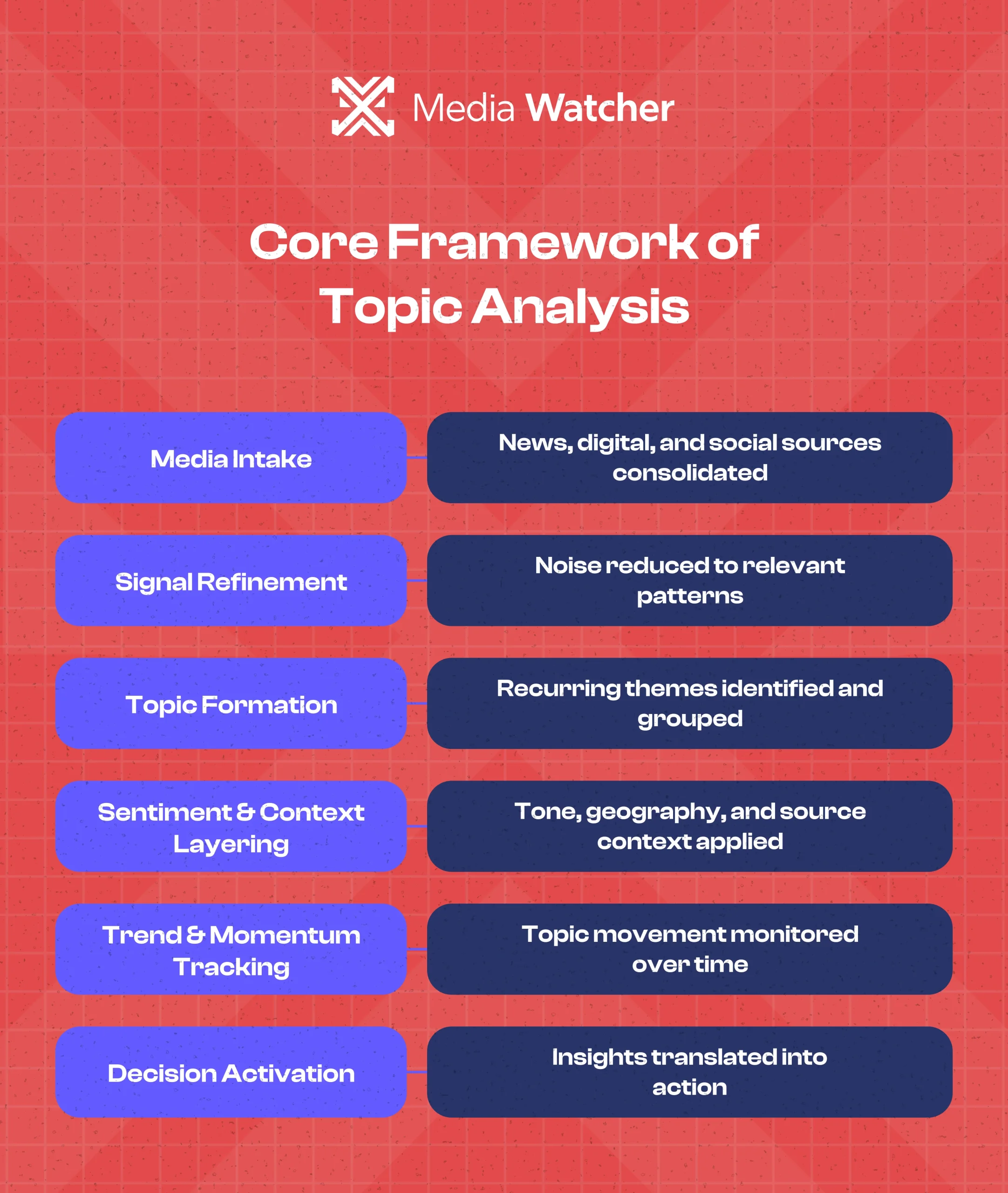
A powerful framework of topic analysis is more than mere tagging. It needs a structure, explanation, and context.
An effective topic analysis framework starts with the first step of the ladder. General topics like regulation or government policy need to be subdivided into digestible topics instead of empty observations.
Second, the diversity of sources is crucial. A quality strategy involves using both international news, local sources, social editors, and reputable online sources to prevent bias.
Third, temporal monitoring is value-added. During a spike, peak, or drop, insight into how topics gain strength, fall, and stabilize over time serves to alert teams to changes in momentum.
Lastly, context enrichment provides insight into life. With topic trends in combination with sentiment, volume changes, and geography, the analysis is actionable, not descriptive.
It is at this point that the advanced topic analysis tools start to differentiate themselves from the rudimentary media tracking platforms.
How Teams Build Topic Analysis into Daily Workflows?
It does not need complex restructuring to build a topic-focused approach. It begins with clear goals.
Defining what is most important is first defined by teams. This could be regulatory alterations, brand awareness, policy discussions, or rivalry. Each goal dictates the manner in which the topics are arranged and followed.
The second is continuous topic monitoring. Rather than monthly or quarterly reports, teams regularly review the changes in the topic on a daily or weekly basis to keep pace with the narrative changes.
This is where visualization comes in. Topics clusters, sentiment movement, and regional breakdown dashboards are useful in ensuring that non-technical stakeholders comprehend the insights within a short time.
Gartner reported that organizations that incorporate thematic intelligence into everyday decision-making experience faster response times to emerging problems by more than 30%.
How Topic Analysis Turns Media Signals Into Inform Decision Making?
Contemporary decision-making requires knowledge of trends, rather than merely events. Single headlines can be innocuous, but repeated themes are indications of larger change.
The use of the topic analysis feature aids leaders in predicting threats before they arise. It points out emerging trends, highlights where interest is rising, and points out what stories have the strongest resonance with audiences.
It also facilitates strategic alignment. With a common understanding of the reality of the media, communications, compliance, marketing, and leadership teams can operate instead of competing interpretations.
Above all, it substitutes the reactive decision-making process with proactive insight. Responses are timely, consistent, and credible when the teams understand issues that influence popular views.
How Media Watcher Assists in Topic Analysis Across Global Media?
Media Watcher transforms topic-based insights into a decision-ready intelligence layer.
The platform combines real-time monitoring with advanced sentiment analysis to identify dominant and emerging themes across global media. Instead of manually categorizing coverage, Media Watcher automatically surfaces topic clusters and tracks how narratives evolve.
Competitor benchmarking enables teams to assess the topic share of voice, which aids in determining where competitors are attracting or receiving criticism. Visual reporting dashboards transform difficult data into simple insights that can be immediately acted upon by the stakeholders.
Through multilingual news coverage in the regions, Media Watcher makes sure that no important dialogue is missed because of language differences. It can be tracking policy debates, brand reputation, or industry risks, but Media Watcher provides clarity at scale. This renders the topic analysis not only informative but also operationally effective.
Contact the Media Watcher team to book a demo today.