



The recent directive by President Trump to disallow student loan relief to nonprofit workers has sparked much controversy throughout the U.S. The initiative, which is centered on the prevention of inappropriate activity in nonprofits, has divided public opinion into two distinct categories. Some see it as a direct attack on public service employees who have been on forgiveness programs, whereas some applaud it as protection against abuse of taxpayer-funded welfare. The gap is apparent, emotional, and getting more vocal on social media.
What the Media Watcher Media Monitoring Dashboard Shows?
Although there are clearly conflicting views on the issue of Trump denying student loan forgiveness, the figures of Media Watcher provide a more detailed view of how widespread and emotional these responses are.
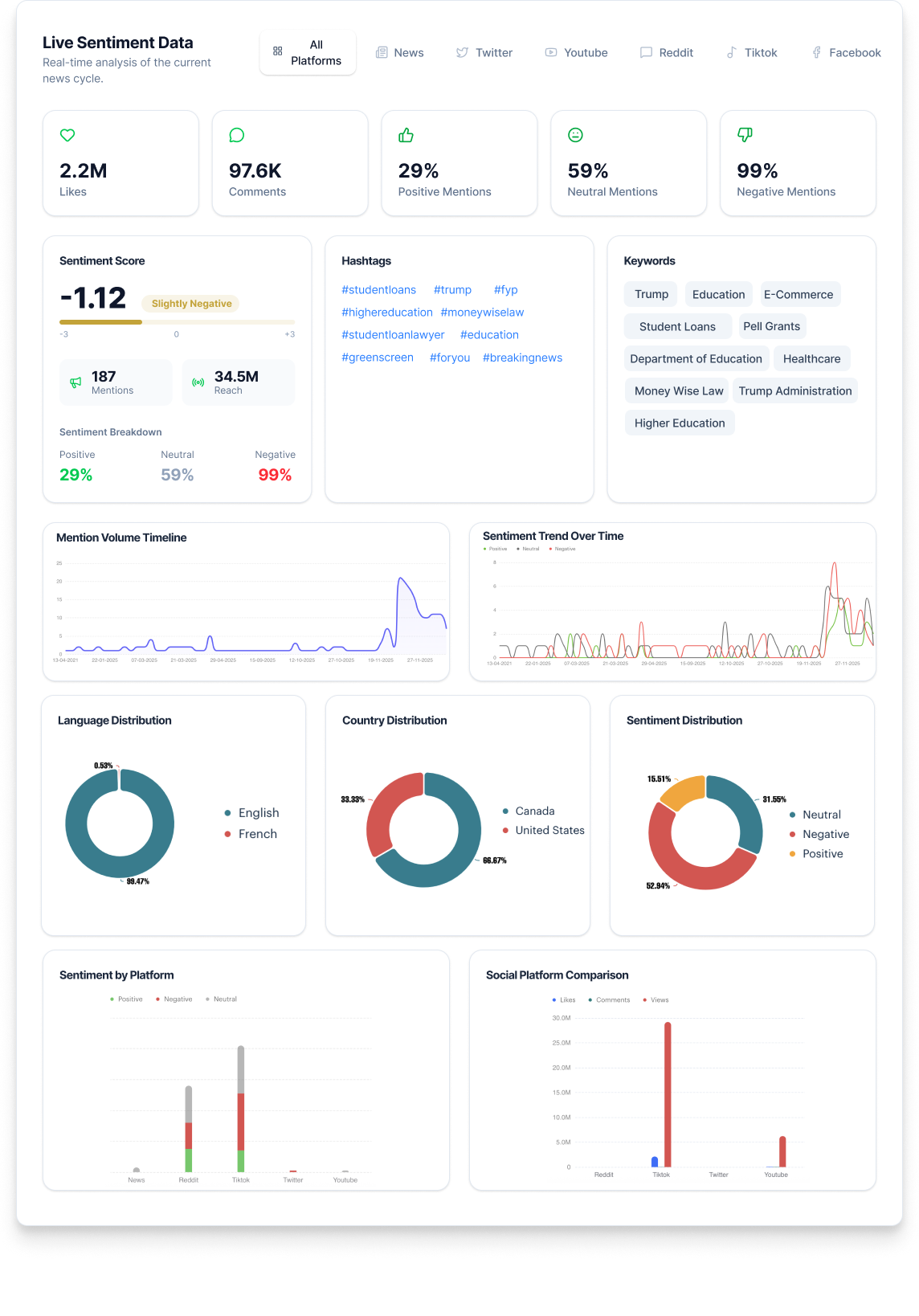
The media monitoring insights provide a clear picture of the public response, as there are 187% mentions, which reached 35.4 million people; the discussion is not silent. The sentiment score is slightly negative (-1.12), which is a sign of overall disapproval, especially from those who are directly impacted. Analyzing the numbers, 52% of mentions are negative, 31% are neutral, and only 15% are positive, which means that the majority of the discussion is biased toward criticism.
Regionally, the U.S. is leading the discussion, and Canada is a minor player, implying global interest with a largely domestic focus. The data peak in late November indicates the immediate response following the release of the order.
The evidence reveals that the most common hashtags are: #studentloans, #trump, #highereducation, and #moneywiselaw, which help to indicate the main aspects of the discussion. This spike indicates that the volume of public attention is not only high but also emotional and filled with frustration, worry, and the discussion of fairness.
The predominance of negative mentions indicates that the nonprofit workers and the supporters of the public service directly feel targeted, and debates regarding the fairness and accountability of the government are heightened.
Popular Responses on Student Loan Relief: Two Sides to the Story
The responses demonstrate two extremely contrasting views. On the one hand, nonprofit employees, teachers, and advocates of public services feel attacked and frustrated. Their efforts, which are frequently mission-oriented and community-based, are now viewed as something that may not be eligible to receive relief, a policy that they view as diminishing the very community that serves society. The feeling of this group is driven by personal interests as well as by the more general thought that the governmental support of the public service should not be altered.
Meanwhile, opponents of the student loan forgiveness program, such as fiscal conservatives and certain policy watchdogs, interpret the order as a necessity. In their argument, they claim that relief must not be given to those individuals who are involved in what they believe is political or improper activity in tax-exempt organizations.
This is associated with more general norms of responsibility, financial restraint, and distrust of governmental excesses. The difference between the opinions of these two groups is political and extensively culturally indicative of divergent thoughts regarding service, taxation, and fairness.
Broader Context and Implications of Trump’s Denial of Student Loan Forgiveness
This policy change does not exist in a vacuum. These rollbacks were a stark contrast to student loan forgiveness programs that expanded access to public service workers under the Biden administration. The complaints of the Freedom From Religion Foundation regarding possible breach of the Johnson Amendment introduce legal and ethical dimensions to the debate.
In the case of nonprofits, the shift brings concerns regarding freedom in operations and the possibility that employees can self-censor to be eligible to receive relief. In addition to policy, the discussion deals with the value of society to the work of the public service, the governmental role in the promotion of nonprofit activities, and the political tension that affects ordinary people.
Companies monitoring sentiment understand the importance of real-time media intelligence. Media Watcher identifies regional variations, points out conversation surges, and even identifies subtle sentiment changes, including the slight downward bias in this case. Teams are able to debate opposite opinions, get notifications about arising scandals, and sift through discussions on international channels not only of what people have to say but also of why they think so.
Media Watcher’s data-driven insights enable practitioners to outpace societal discourse, interpret the mood in real-time, and act strategically based on how the public responds to particular crises.
Contact the Media Watcher team to book a demo today.