



The debate on whether Donald Trump helped negotiate a Gaza ceasefire has now become one of those few instances when two different audiences will watch the same story and tell entirely different narratives. The agreements provide relief to the Palestinian civilians, which is a rare diplomatic breakthrough, following years of exhaustion in conflicts. That relief is accompanied by an intense mistrust among Israeli citizens, because there is a recollection of past ceasefires failing, a mistrust in politics, and a long-time assumption that agreements in this region seldom last. This disconnect is obvious, agonizing, and disproportionately loud.
What Media Watcher Data Shows about the Gaza Ceasefire and US Agenda?
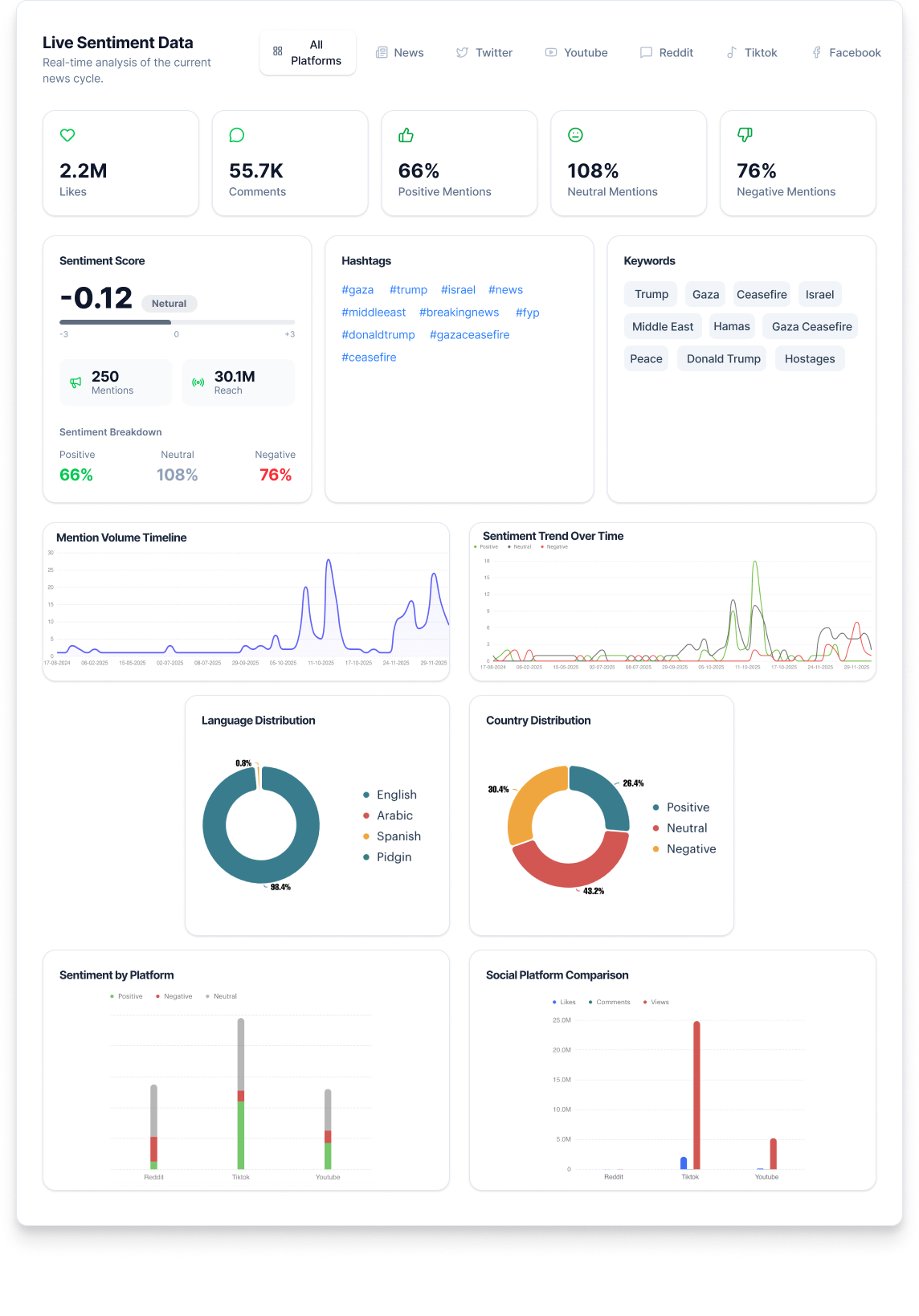
The Media Watcher sentiment numbers reveal the Gaza ceasefire and the US agenda rift in a manner that scrolling through feeds never did. The results indicate 26% positive, 43% neutral, and 30% negative detailed mentions, producing the overall sentiment score of -0.12. The tone is almost neutral but is tilted towards skepticism.
Other dashboard indicators show 30.1M total reach, which suggests this discussion did not stay in the niche communities but also reached the mainstream audience on the platforms. This is not a mere interaction with 2.2M likes and 55.7K comments. People are not just reading; they are also arguing.
The very hashtags are a narrative: #gaza, #trump, #gazaceasefire, #israel, #breakingnews, a combination that reflects not only the geopolitical seriousness of the situation but also how fast the subject is going viral.
One of the most significant details in the data is the atypical high percentage of neutral to negative mentions. The conversation is dominated by neutral mentions, which the dashboard indicates are provided by accounts that share raw updates without comments. It is an indication that individuals were not certain about how to react during the initial hours, which is typical of news involving conflict. Within the negative mentions, 76% focus on a single fear:
“This won’t last.” That spike shows widespread distrust toward any Middle East ceasefire and, at times, toward the brokers who negotiate them.
Regional Contrast of Hope and Hesitation Over the Gaza Ceasefire
The division is not arbitrary around the Gaza ceasefire news; it has distinct cultural and political boundaries. Younger voters and foreign observers in the U.S. coastal cities have a higher chance of understanding the ceasefire as a long-awaited de-escalation. They view hostage release and the gradual retreat of the forces as proof that even Trump-type diplomacy could move something as stagnant as the Gaza war. Their optimism is cautious, but real.
By moving towards conservative-leaning areas, the tone changes quickly; that’s where the skepticism dominates. There are those who worry that the ceasefire will reward troublemakers. Other people believe that it will not materialize since past deals did not succeed. For many long-time observers of the region, Trump’s involvement adds another layer of distrust, while for his supporters, it becomes one more reason to applaud the development. These conflicting interpretations are not just political but mirror profound insecurities over regional stability, alliances across the globe, and the question of whether diplomacy led by Americans still means anything.
A Broader View of the Tension Behind the Ceasefire
The wider context around the Gaza ceasefire and the US agenda renders the social split unavoidable. Trump’s foreign policy legacy is already divided, and linking his name to a Gaza ceasefire only heightens those existing divides. Tack on two years of war, humanitarian pressure, and audiences exhausted by regular ceasefire collapses, and the outcome is a future in which sentiment may flip abruptly between hope and frustration.
The deal is usually supported by exhaustion, and opposition to it is influenced by the long history of failures. In their own right, both reactions make sense.
These large-scale resolutions, such as the Gaza ceasefire, demonstrate how fast the mood can shift and how territories can respond in various ways. Media Watcher puts these changes into a clear perspective, tracing the increasing conversations, emerging rifts, and the tone that defines the attitudes of the people across the Middle East. It cuts noise, points at meaningful spikes, and assists teams in chasing the story before it becomes the next headline. In a cycle where things are rapidly evolving, and the locality is at play, such clarity is crucial to one who wants to keep ahead of the story.