



 The UK’s new immigration rules have split public reaction along two very defined lines. Health-sector unions, migrant nursing staff, and NHS workers are warning that the long ILR timeline may drive thousands of skilled professionals off, exacerbating existing shortages already putting pressure on hospitals. Conversely, the immigration-control activists, government-aligned policy lobbyists, and anti-border voters in areas where increased restrictions are more desired claim that the reforms are needed to restore equity and reduce long-term migration dependency. These groups are not talking at cross purposes, but they are addressing two very different realities, and the debate is escalating.
What Media Watcher’s Dashboard Reveals About Sentiment on UK Immigration Changes?
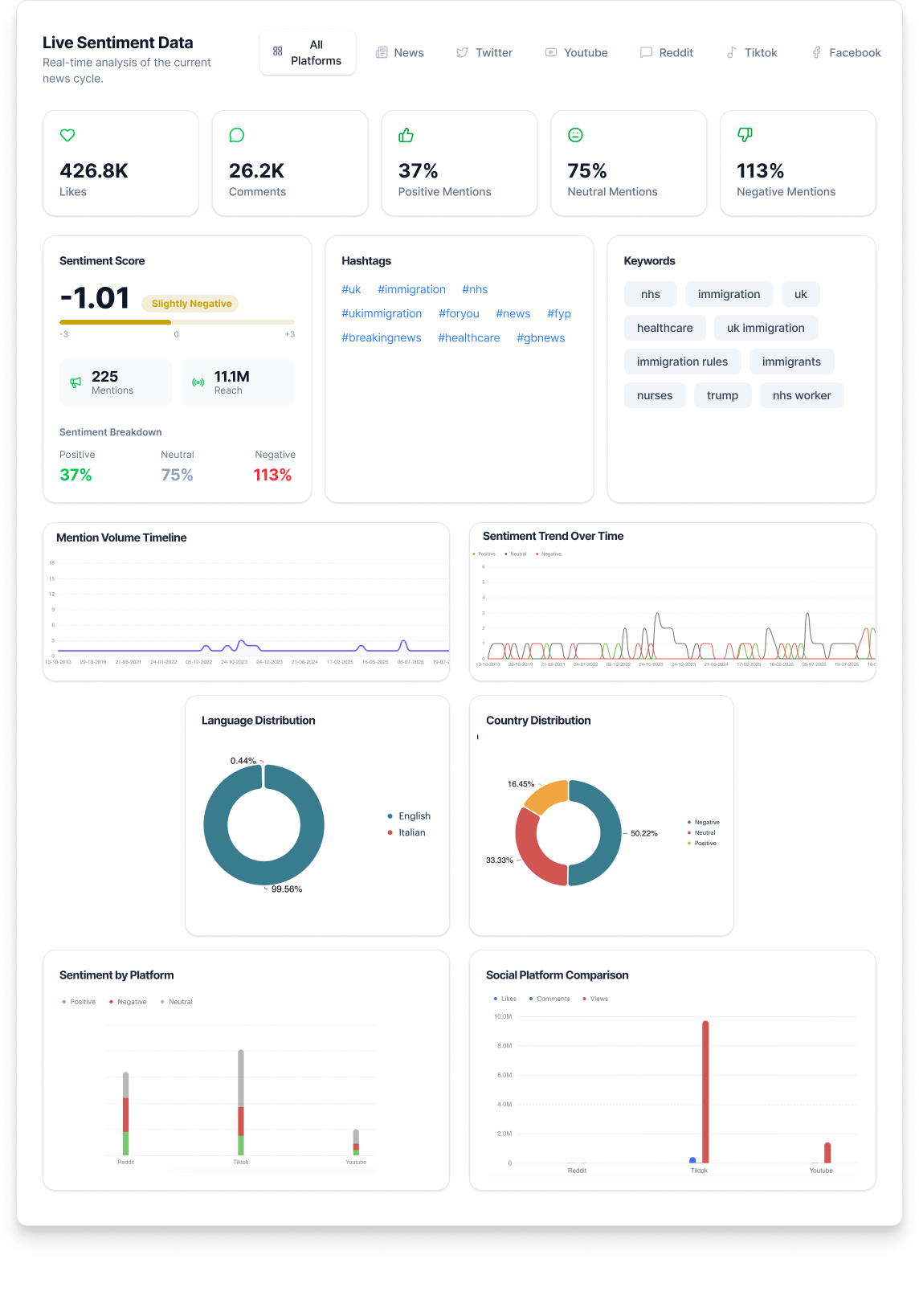
The Media Watcher’s media monitoring dashboard shows a -1.01 sentiment score, a slightly negative tilt driven mostly by frustration inside healthcare circles. Out of 225% mentions, 50% are negative, and only 16% positive, which mirrors the anxiety around losing up to 50,000 migrant nurses due to extended ILR qualifying periods.
The 11.1M reach signals that this conversation has jumped beyond policy experts. The wide distribution, paired with 426.8K likes, suggests content about NHS risk is resonating emotionally, not just informationally.
The data suggests that supporters of the reforms are quieter but steady, which is reflected in the higher neutral count (75%), often post-debating immigration fairness or cost controls without referencing healthcare directly.
In the meantime, the spikes in hashtags such as NHS, immigration, healthcare, and ukimmigration indicate that the center of gravity in the issue is covered with the anxieties about staffing collapse. The keywords that are all over the nurses, immigrants, and immigration regulations indicate that the discussion is not abstract; it is job-related.
Sentiment trend lines from the dashboard reveal short bursts of positive sentiment, typically coming from users highlighting the need to protect local jobs or praising government efforts to “fix a broken system.” But the sustained negative trend stems from healthcare regions reacting to real staffing implications.
Why are UK Immigration Policy Changes Splitting Public Opinion on NHS Staffing?
The two groups are responding on very different grounds, both geographically and emotionally.
Areas of high concentration of NHS jobs, like London, Birmingham, Manchester, and Scotland, are more concerned. Those regions are highly reliant on foreign medical professionals, and that fact defines what they are afraid of. The reforms seem to be a policy written well above the hospital floor, by those in charge who do not see the gaps in the night shift or the already overcrowded wards.
In opposition, proponents of more restrictive immigration policies are more evident in areas with less concentration of migrant workers in the Midlands, Kent, Essex, and in some of the North East. In this case, the framing relates less to staffing and more to sovereignty, wage protection, and long-term demographic pressures. This emotional impulse is not the anger toward migrants, but the perception that the system is to remain stable and predictable.
Thus, a conversation formed by lived experience where cities are under pressure due to NHS shortages, versus regions where immigration is perceived through the lens of economic competition and cultural transformation. The gap is widening not because either party is irrational, but rather because they are responding to various realities of everyday life.
How UK Immigration Reforms Fit Into the Wider Healthcare and Workforce Framework?
The issue of immigration reform in the UK has always been politically charged, but the factor of the NHS brings in a layer to the issue that cuts across ideology. International workers have been serving the health service since its inception, and now, almost one out of five employees of the NHS is a foreign national. The extension of ILR times has an impact not only on the workers but also on their stability, housing choices, and family life.
Simultaneously, the housing strain, the lack of increase in wages, and the salaries, immigration becomes a delicate subject in areas where jobs in the field of healthcare are less. Thereby, two realities are defining the policy debate, namely, a great national need to have immigration order and a great need to be dependent on global healthcare talent.
For policymakers, NHS leaders, and public-sector teams trying to navigate conversations as polarised as immigration and healthcare, clarity matters more than volume.
Media Watcher cuts through the emotional noise by mapping sentiment shifts in real time, showing which regions are pushing back, where support is building, and how frontline staff differ from the general public.
With regional heat-mapping, smart filtering, and platform-wise sentiment breakdowns, Media Watcher helps decision-makers understand the public mood before it hardens. When the debate moves, the policymaking teams check it immediately to help in better decision-making.