

Most brands assume that a simple Google search will provide adequate insights into their reputation, but it is just the tip of the iceberg of what they actually represent online.
Research indicates that 90% or more of online discussions about a brand occur beyond the news media, spread across social media, blogs, forums, and podcasts. Searching for a brand or a campaign with a simple Google query provides fragmented search results, where critical mentions and insights about the audience are lying in the open ocean. Media tracking alters the game by continuously monitoring all corners of the digital ecosystem, taking real-time mentions, and understanding sentiment, reach, and influence.
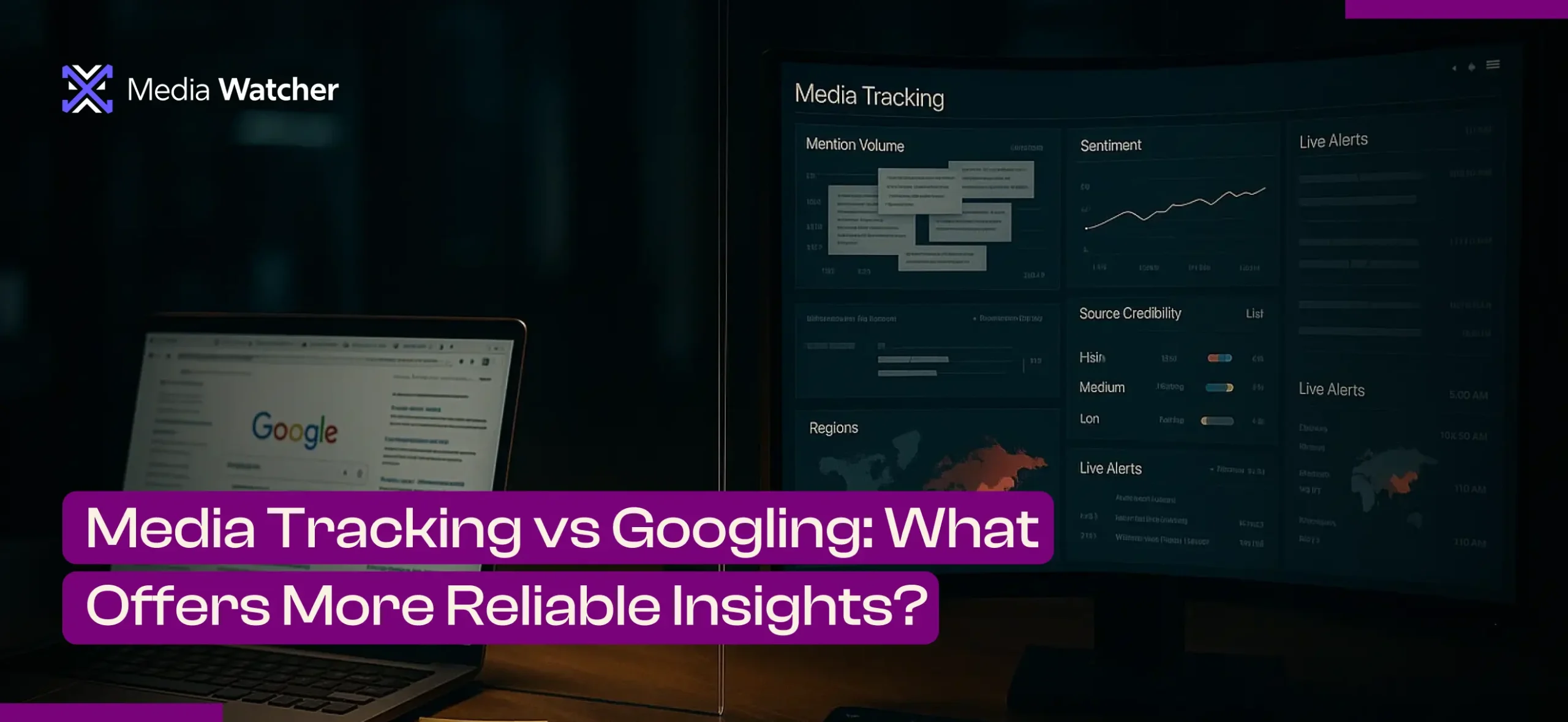
Media tracking, in contrast to static search results, is a system that organizes information into detailed dashboards, identifies emerging trends, and converts raw mentions into actionable intelligence. It offers the speed and clarity that manual Googling cannot replicate to brands that hope to remain ahead of their competitors and react more quickly to opportunities or crises.
What is Media Tracking?
Media tracking refers to the systematic process of tracking and analyzing brand mentions in all types of media. Contrary to basic Google searching, it can record real-time conversations on news portals, social sites, forums, podcasts, and television stations, giving a comprehensive picture of how a brand is viewed. In addition to determining what is being said, it uncovers context, sentiment, reach, and influence, enabling brands to transform disjointed mentions into actionable insights.
The true worth of media monitoring tools is that they reveal trends, uncover new problems, and assess audience and influencer effect. The advanced media tracking platform uses AI and analytics to transform raw data into strategic intelligence, enabling brands to act proactively, optimize campaigns, track competitors, and maintain their reputation. In the current media environment, which is fast and dynamic, media tracking keeps organizations updated, flexible, and on top of the discussion.
Major Differences between Media Tracking and Googling
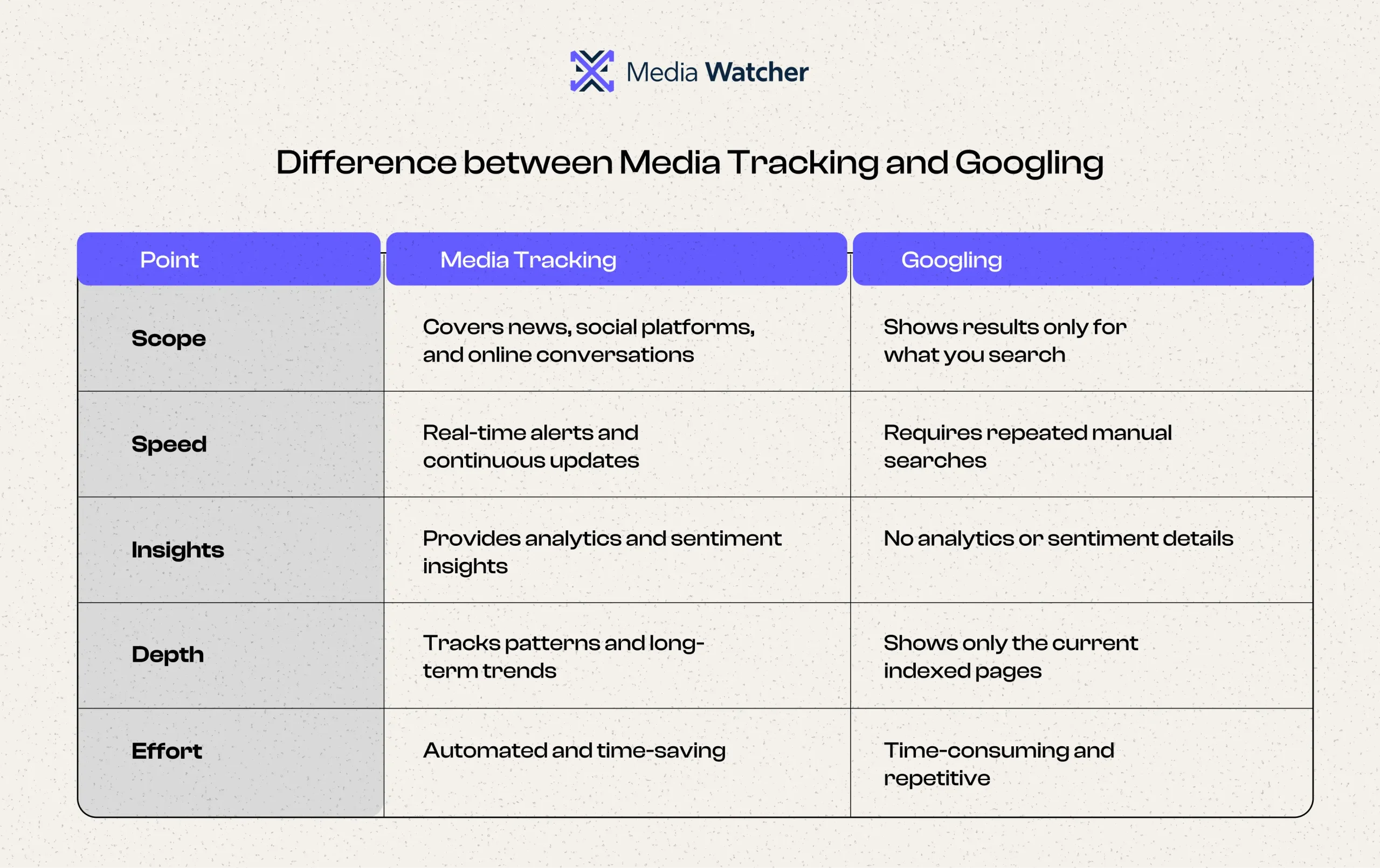
Media tracking and Googling are not similar, but they are used by brands and businesses with entirely different purposes. Media tracking is a constant tracking of internet discussions, providing real-time insights, sentiment analysis, and trend patterns to aid in strategic decision-making. By contrast, Googling only provides the results of a certain search, with limited scope, no sentiment information, and a fixed perspective of indexed webpages. Whereas media tracking is automated and allows one to see deeper trends with minimal work, Googling is a dull and time-consuming task, which lacks the actionable insight required to actually learn how people behave or perceive a brand.
How Media Tracking Actually Works?
The concept of media tracking might appear like magic, but it is a well-organized procedure that can transform random mentions of media into clear and actionable insights. Contemporary media tracking systems perform a constant scan of various sources, interpret the data, and deliver it in a format that benefits the brands, knowing the trends, sentiment, and audience behavior in real-time. The following are the steps involved in the media tracking procedure:
1. Establishing Monitoring Parameters
Brands define what to track, whether company names, products, campaigns, keywords, or competitors. This guarantees that the system only emphasizes relevant mentions in all media channels.
2. Gathering Information from Multiple Data Sources
It searches and indexes news portals, blogs, forums, podcasts, social media, and broadcasts, and retrieves all references that fit the search parameters.
3. Filtering and Sorting Mentions
Raw data is cleaned to eliminate useless mentions and duplicates. The mentions are divided according to source, topic, and date, which makes it simple to navigate and examine.
4. Sentiment and Engagement Analysis
High-tech tools utilize AI to identify sentiment (positive, negative, neutral) and engagement metrics (shares, comments, reach), providing a more profound insight into the perception of a population.
5. Trends and Patterns Detection
Media intelligence solutions help brands to predict changes or react to problems before they occur by detecting recurring patterns or spikes in conversations or audience behavior.
6. Reporting and Alerts
Instant notifications and auto-generated reports will keep the teams informed about the critical mentions, new trends, or possible emergencies, which allows a prompt and strategic response.
Why Media Tracking Outperforms Googling for Brand Insights?
Brands are competing in a world where discussions take place on several platforms at once, viral posts on social media or niche forums, and breaking news websites. The process of searching manually, using Google, and trying to find mentions usually provides partial results, leaving gaps in comprehension and necessitating re-purposing of the activity in order to follow current trends.
The most important mentions may be hidden under the irrelevant results, and the upcoming trends are frequently identified too late. Research demonstrates that during digital discussions, activity can peak within hours, so even a slight delay in monitoring can lead to missed opportunities or reputational risks.
Media tracking makes this act a real-time, accurate, and strategic benefit. Complex platforms constantly record mentions in various channels, labeling the most useful sources and displaying sentiment, influence, and engagement trends at a glance. Brands can take proactive steps instead of reactive ones by identifying the trending topics early, sudden negative sentiment spikes, and proactive voices discussing an issue.
Practically, what might otherwise require hours of manual Googling and analysis can be provided in real time, transforming disjointed digital chatter into actionable intelligence and providing organizations a competitive advantage in a rapidly accelerating media world.
How Media Watcher Sets the Benchmark for Advanced Media Tracking?
Media Watcher establishes the standard of high-technology media tracking by providing real-time, detailed, and in-depth information that cannot be matched by manual Googling. It extends further than superficial searches, identifying replies in news outlets, blogs, forums, and social media for understanding tone, reach, and involvement. The platform transforms scattered data into a structured overview, making brands informed and quicker in making strategic decisions.
That’s how Media Watcher outperforms manual Googling:
Real-Time Monitoring: Tracks mentions appear in real-time across various channels, whereas Google only offers the results of the search.
Comprehensive Coverage: Gathers news, blogs, social media, forums, and niche sources not easily found through Googling.
Sentiment & Analytics: Measures tone, engagement, and influence, which cannot be generated by manual search.
Pattern Detection & Trend Detection: Recognizes new tendencies and repetitive issues, which allows taking preemptive measures.
Efficiency in Time and Effort: Automates data collection and reporting and saves hours of manual searching and analysis.
Contact the Media Watcher team to book a demo today.